
Learning how to reference online sources is an important part of academic writing. Students, researchers, teachers, and writers regularly use websites to collect information for essays, assignments, reports, and research papers. However, using information from a Website Reputation Monitoring also means giving proper credit to the original source.
If you are wondering how do you reference a website in mla format, the process becomes much easier when you understand the basic rules of MLA 9th edition. You need to identify the important details of a webpage, arrange them in the correct order, and create a matching in-text citation when you use information from that page.
Many students search for how do you reference a website in mla format because online sources do not always provide the same information. One webpage may show an author and publication date, while another may only display a title and URL. Knowing how to handle these differences can help you prepare accurate citations.
This guide explains how do you reference a website in mla format in simple language. You will learn the basic citation structure, understand each part of a Works Cited entry, explore examples, and discover how to handle webpages with missing information.
What Is MLA Format? Understanding MLA 9th Edition
MLA format is a writing and citation style developed by the Modern Language Association. It is commonly used in subjects such as English, literature, language studies, cultural studies, and other humanities fields.
The current edition is the MLA Handbook, Ninth Edition. It uses a flexible system called core elements. These elements help writers cite different types of sources, including websites, books, journal articles, videos, and online publications.
You can explore the official guidance through the MLA Style Center, which provides explanations and examples for different citation situations.
Why Are MLA Website Citations Important?

A website citation does more than show where you found information. It also helps you:
- Give credit to original authors: Acknowledge the people and organizations responsible for the information you use.
- Avoid plagiarism: Make it clear which ideas come from another source.
- Support your arguments: Show readers that your statements are supported by published information.
- Help readers find sources: Provide enough information for someone to locate the original webpage.
- Build academic trust: Present your research in a clear and organized way.
Understanding how do you reference a website in mla format also helps you keep your research organized. When you record source details as you work, you are less likely to lose important information before completing your assignment.
How Do You Reference a Website in MLA Format? The Basic Citation Structure
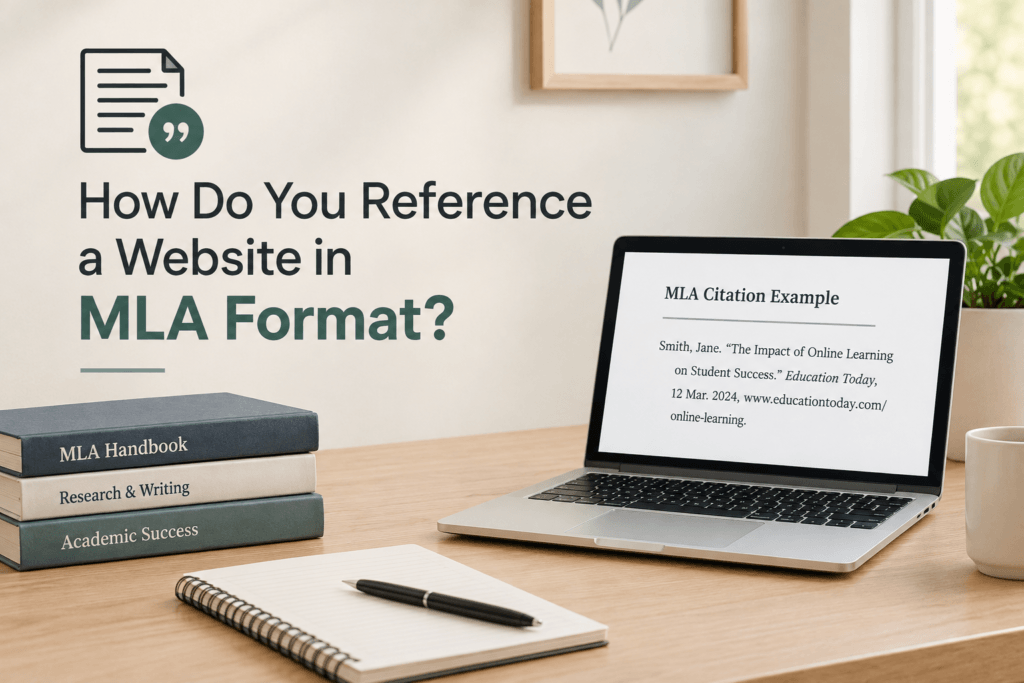
An MLA Works Cited entry for a webpage is created using the information available on that page. The core elements usually include the author, title of the source, title of the website, publisher, publication date, and URL.
A general structure looks like this:
Author. “Title of the Webpage.” Title of the Website, Publisher, Publication Date, URL.
Not every webpage contains all these details. If an element is missing, you should not invent it. Instead, follow MLA guidance for the information that is actually available.
Here is a simple example using fictional information:
Taylor, Morgan. “Simple Ways to Improve Online Research.” Example Learning Center, Example Publishing, 12 Mar. 2025.
This example shows how the different elements work together. The author’s name appears first, followed by the webpage title in quotation marks. The website title is italicized, and the remaining publication details follow.
If someone asks how do you reference a website in mla format example, this basic structure is a useful starting point. However, always check the details of the actual webpage before preparing your final entry.
MLA Citation Core Elements: What Information Do You Need?
Before creating a citation, collect the information available on the webpage. MLA uses a set of core elements that can help you organize this information.
Knowing these elements makes it easier to understand how do you reference a Website Architecture in mla format when a webpage contains several different publication details.
1. Author Name
The author is the person or organization responsible for creating the content.
For an individual author, write the last name first, followed by the first name.
Example:
Taylor, Morgan.
If the webpage has two authors, list the first author’s last name first, followed by the second author’s name in normal order.
Example:
Taylor, Morgan, and Alex Smith.
For three or more authors, list the first author’s name followed by et al.
Example:
Taylor, Morgan, et al.
If no author is identified, begin the citation with the webpage title. Do not use the website’s name as the author unless it is genuinely responsible for the content.
2. Title of the Webpage
The webpage title identifies the specific article, post, report, or page you are using.
Place the title inside quotation marks.
Example:
“How to Build Better Study Habits.”
Use the wording shown on the actual webpage. Do not create a different title simply to make your citation sound better.
3. Title of the Website
The website title identifies the larger website where the webpage appears.
Write the website name in italics.
Example:
Example Learning Center
Remember the difference:
- Webpage title: “How to Build Better Study Habits.”
- Website title: Example Learning Center
The webpage title identifies the individual content, while the website title identifies the platform that published it.
4. Publisher
The publisher is the organization responsible for making the website or content available.
For example, a university may publish an educational webpage, while a company may publish an article on its official website.
If the publisher is the same as the website title, MLA generally does not require you to repeat it. This helps avoid unnecessary duplication.
5. Publication Date
The publication date tells readers when the webpage was published or updated.
You may see dates written in different ways on websites. In an MLA Works Cited entry, use the date format:
12 Mar. 2025
If the page displays a reliable publication or update date, include it. If no date is available, do not guess.
6. URL
The URL is the web address that takes readers to the source.
For example:
www.example.com/research-guide
Use the URL of the specific webpage rather than the website’s homepage whenever possible. MLA generally omits the http:// or https:// part of a URL.
7. Access Date
An access date tells readers when you viewed the webpage.
MLA does not require an access date for every online source. However, it can be useful when a webpage has no publication date, changes frequently, or may be difficult to locate later.
Example:
Accessed 18 Oct. 2026.
Only include an access date when it is useful or required by your instructor.
9 Steps to Create an MLA Website Citation
Now that you understand the core elements, you can create a citation by following these nine practical steps. These steps provide a straightforward way to understand how do you reference a website in mla format without missing important publication details.
Step 1: Open the Original Webpage
Start by opening the exact webpage you used in your research.
Do not rely only on a search engine result or a short description shown in search results. Visit the original page and check its content.
For example, if you found an article about online education, open that article instead of citing the website’s homepage.
This matters because a website can contain hundreds of pages, and your citation should direct readers to the specific source you used.
Step 2: Find the Author’s Name
Look near the webpage title, below the headline, or at the end of the article. Many websites display the author’s name near the top.
- If an individual wrote the article, record their full name.
- If an organization is responsible for the content, record the organization’s name when appropriate.
- If you cannot identify an author, do not make one up. You can begin the citation with the webpage title instead.
Step 3: Copy the Exact Webpage Title
Find the main title of the content.
Make sure you record the title of the individual webpage, not the website’s name or a category heading.
For example:
- Webpage title: “Understanding Digital Marketing.”
- Website title: Example Business Journal.
The first title identifies the article, while the second identifies the publication.
Step 4: Record the Website Name
Next, identify the name of the website where the article appears.
You can usually find it in the website header, logo, browser tab, or publication information.
Write this name in italics in your final citation.
Step 5: Identify the Publisher
Check whether the website identifies a publisher or organization responsible for the content.
For example, a university website may identify the university as its publisher.
If the publisher and website name are identical, you generally do not need to repeat the same name in the citation.
Step 6: Find the Publication or Update Date
Look for the date near the article heading or author information.
Some websites also display an updated date. If the page provides a clear and relevant publication or revision date, use the appropriate date.
Do not use the current date as the publication date simply because the page does not show one.
Step 7: Copy the Specific Webpage URL
Copy the direct URL of the page you used.
Avoid using a homepage URL when you are citing an individual article. A direct link makes it easier for readers to locate the exact content.
Also, check that the URL works and does not contain unnecessary tracking information.
Step 8: Arrange the Information in MLA Order
Now organize the details using the MLA core elements.
A typical webpage entry follows this order:
- Author.
- Title of the source.
- Title of the container, such as the website.
- Publisher.
- Publication date.
- Location, such as the URL.
Not every source includes all six elements. Use only the details that are available and relevant.
Step 9: Add the In-Text Citation and Check Your Work
After creating the Works Cited entry, add an in-text citation wherever you use information from the source.
For a webpage with an author named Morgan Taylor, a basic parenthetical citation may look like this:
(Taylor)
If the webpage does not have page numbers, do not invent them. Use the author’s name or another appropriate identifying element.
Finally, compare your in-text citation with the Works Cited entry to make sure readers can connect the two. This final check is an important part of how do you reference a website in mla format correctly.
MLA Website Citation Examples for Different Situations
Websites do not all display information in the same way. Some include author names and dates, while others publish content without identifying an individual writer.
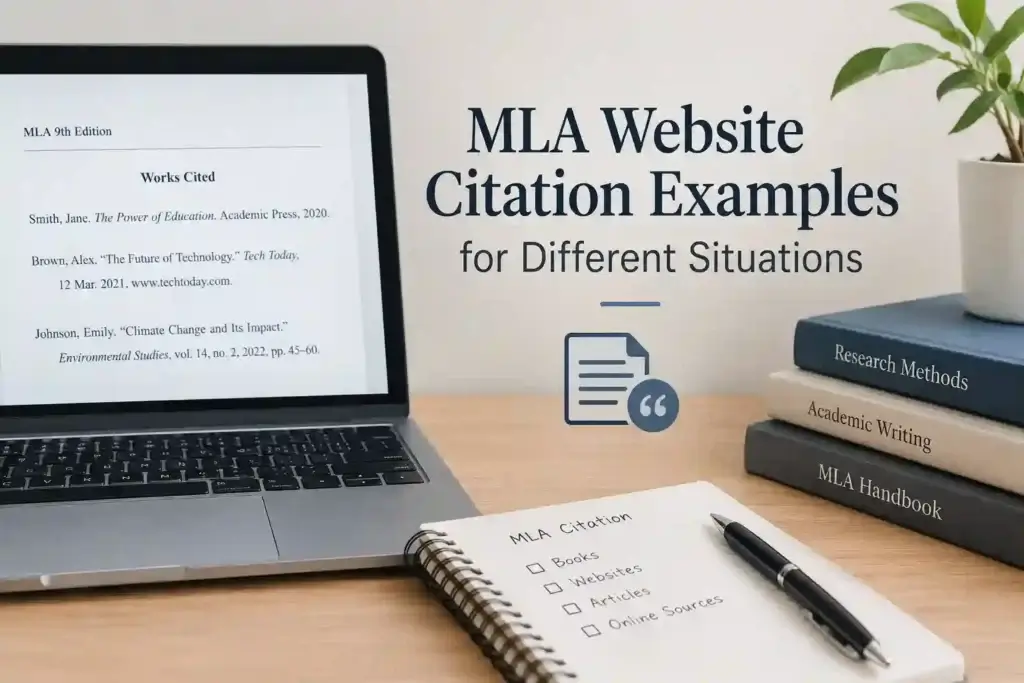
The following examples use fictional publication details to demonstrate the citation patterns. Replace the sample information with the details from your actual source.
Website Citation With One Author
When a webpage has one named author, begin with the author’s last name.
Example:
Taylor, Morgan. “How to Improve Your Research Skills.” Example Learning Center, Example Publishing, 12 Mar. 2025.
In-text citation:
(Taylor)
This is one of the most straightforward citation situations because the author and publication information are available.
Website Citation With Two Authors
When a webpage has two authors, include both names. Write the first author’s last name first, followed by the second author’s name in normal order.
Example:
Taylor, Morgan, and Alex Smith. “A Guide to Online Learning.” Example Education Journal, 8 Apr. 2025.
In-text citation:
(Taylor and Smith)
Make sure the names in your in-text citation match the authors listed in the Works Cited entry.
Website Citation With Three or More Authors
For a webpage written by three or more authors, list the first author’s name followed by et al.
Example:
Taylor, Morgan, et al. “New Approaches to Digital Education.” Example Research Review, Example Publishing, 15 May 2025.
In-text citation:
(Taylor et al.)
The abbreviation et al. means “and others.” It keeps the citation concise while acknowledging the full author group.
Website Citation With No Author
Some websites do not identify an individual author. In that situation, begin with the webpage title.
Example:
“How to Prepare for an Online Examination.” Example Student Guide, Example Publishing, 6 June 2025.
In-text citation:
(“How to Prepare”)
Use a shortened version of the title in the in-text citation. Keep the title in quotation marks because the source is a webpage or article.
If you are researching how do you reference a website in mla format when no author is listed, this title-first approach is an important rule to remember.
Website Citation With No Publication Date
If a webpage does not show a publication or update date, do not invent one.
Example:
Taylor, Morgan. “A Beginner’s Guide to Academic Research.” Example Learning Center.
If you need to show when you accessed the page, you may add an access date:
Taylor, Morgan. “A Beginner’s Guide to Academic Research.” Example Learning Center. Accessed 18 Oct. 2026.
In-text citation:
(Taylor)
Website Citation With No Author and No Date
If the page has no identifiable author and no publication date, begin with the title and include the available website and location information.
Example:
“Student Research Resources.” Example University Library.
In-text citation:
(“Student Research”)
Do not add a made-up author or publication date to complete the entry.
Website Citation for an Organization or Government Website
Sometimes an organization, institution, or government department is responsible for the webpage.
Example:
World Health Organization. “Example Public Health Guidance.” World Health Organization.
If the organization is both the author and the website publisher, avoid repeating the same name unnecessarily. Follow the structure recommended by MLA for the specific source.
For students researching how do you reference a website in mla format for an official government or organization page, it is especially important to identify who is responsible for the content. Do not automatically treat the website’s domain name as the author.
For official guidance, consult the MLA Style Center.
Website Citation for an Online News Article
Online newspaper and news articles can also be cited using the MLA core elements.
Example:
Brown, Jamie. “New Technology Trends in Education.” Example Daily News, 14 Aug. 2025.
In-text citation:
(Brown)
If the article appears in an online publication, italicize the publication name and place the article title in quotation marks.
MLA In-Text Citations for Websites
A Works Cited entry provides complete publication information at the end of your paper. An in-text citation appears in the body of your writing and points readers toward the relevant entry.
For example:
Online learning can give students more flexibility when managing their studies (Taylor).
The citation uses the author’s last name because the webpage does not have page numbers.
Understanding the difference between these two citation types is an important part of how do you reference a website in mla format. You need the full entry at the end of your paper and a matching citation in the paragraph where you use the source.
In-Text Citation With an Author
When a webpage has an author, use the author’s last name in parentheses if the name is not already mentioned in your sentence.
Example:
Online research requires careful evaluation of sources (Taylor).
You can also mention the author directly in your sentence:
Taylor explains that careful research helps readers evaluate online information.
When the author’s name is already included in the sentence, you generally do not need to repeat it in parentheses.
In-Text Citation Without an Author
When a webpage does not have an author, use a shortened version of the title.
Example:
(“Student Research”)
If the title is long, shorten it to the first meaningful words. Keep the formatting consistent with the way the title appears in the Works Cited entry.
In-Text Citation Without Page Numbers
Most webpages do not have stable page numbers. Therefore, you should not create page numbers yourself.
If the webpage does not provide page numbers or another suitable numbered location, use the author’s name or shortened title as appropriate.
For additional guidance, read the MLA Style Center’s overview of in-text citations.
How to Format the MLA Works Cited Page
After citing sources in your paper, list them on a separate page titled Works Cited.
The Works Cited page helps readers find the full details of every source referenced in your writing. It is also where the full information from your website citations appears.
Follow these formatting rules:
- Page title: Write “Works Cited” at the top of the page.
- Double spacing: Keep the entries double-spaced unless your instructor gives different instructions.
- Alphabetical order: Arrange entries by the first element, usually the author’s last name.
- Hanging indent: Indent the second and following lines of each entry.
- Consistent formatting: Use the same citation style throughout the page.
What Is a Hanging Indent?
A hanging indent means the first line of a citation starts at the left margin, while the following lines are indented.
For example:
Taylor, Morgan. “How to Improve Your Research Skills.” Example Learning Center,
Example Publishing, 12 Mar. 2025.
This format makes it easier for readers to scan the authors’ names and locate individual sources.
When checking how do you reference a website in mla format for a final assignment, remember that a correct citation also needs to be presented properly on the Works Cited page. You can find additional formatting instructions in the Purdue OWL MLA Works Cited guide.
These checks can help you avoid common problems when applying how do you reference a website in mla format to different types of online sources.
MLA Citation Generators and Helpful Research Tools

Creating citations manually helps you understand the rules, but citation tools can make the process faster. They are particularly useful when you have several sources to organize.
However, an automatic citation generator is not always perfect. It may misunderstand a webpage title, identify the wrong author, or use an incorrect publication date.
You should always review the generated result before adding it to your paper.
MLA Style Center
The MLA Style Center is an official resource for MLA rules and examples. It is useful when you need to check how a particular type of source should be cited.
Purdue OWL
The Purdue Online Writing Lab offers educational guidance about academic writing, research, and citation styles.
Its MLA resources can help students understand Works Cited formatting and citation basics.
Scribbr Citation Generator
The Scribbr Citation Generator can help create MLA-style references. It may save time when organizing multiple sources.
Still, check every result against the original webpage and official MLA guidance.
Why You Should Review Automatic Citations
A citation generator can make mistakes because websites do not always present their information consistently.
Use automatic tools as a starting point, not as a replacement for checking your sources. If you are learning how do you reference a website in mla format, reviewing generated citations is a useful way to understand the rules instead of simply accepting the first result.
Final Thoughts
Creating an MLA website citation may seem confusing at first, especially when different webpages provide different information. However, the process becomes much easier when you understand the core elements and know how to organize them.
With these steps and examples, you can understand how do you reference a website in mla format and prepare clear, consistent references that make your academic writing easier for readers to verify.
For the most reliable guidance, keep the MLA Style Center and Purdue OWL available when checking unusual citation situations.
FAQ’S…
How do you reference a website in MLA format when citing an online source?
Include the author’s name, webpage title in quotation marks, website name in italics, publisher, publication date, and URL. Use only the details available on the webpage and arrange them in the correct MLA order.
How do you reference a website in MLA format using Google Docs?
Open your Google Docs document and select Tools → Citations. Choose MLA from the citation style options, add your website details, and insert the citation. Review the generated reference to ensure it follows MLA 9th edition guidelines.
How do you reference a website in MLA format in the middle of a paper?
Use an in-text citation immediately after the information you borrowed. Usually, include the author’s last name in parentheses, such as (Taylor). If there is no author, use a shortened version of the webpage title.
How do you reference a website in MLA format if you use ChatGPT for citations?
ChatGPT can help organize citation details and explain MLA formatting. However, always verify the author’s name, webpage title, publication date, and URL against the original source. Do not rely on automatically generated citations without checking them.