
Introduction
Understanding match each type of trueview ad to its bidding approach is important for anyone who wants to learn how YouTube video advertising works. Choosing the right video format is only one part of a successful advertising campaign. Advertisers must also select a suitable bidding strategy to support their marketing objectives, manage their budgets, and measure results effectively.
This guide explains match each type of trueview ad to its bidding approach in simple language. You will learn how traditional TrueView formats work, how cost per view (CPV) differs from cost per thousand impressions (CPM), and why cost per acquisition (CPA) and other conversion-focused strategies can be useful for campaign optimization designed to generate leads or sales.
This article explains the original terminology while linking to relevant Google Ads resources for current information.
1. Match Each Type of TrueView Ad to Its Bidding Approach: The Basic Rules
The main principle behind match each type of trueview ad to its bidding approach is simple: select a bidding method that supports the campaign’s primary marketing objective.
Different video ad formats serve different purposes. Some encourage people to watch a video, while others focus on brand awareness, visibility, or valuable customer actions.
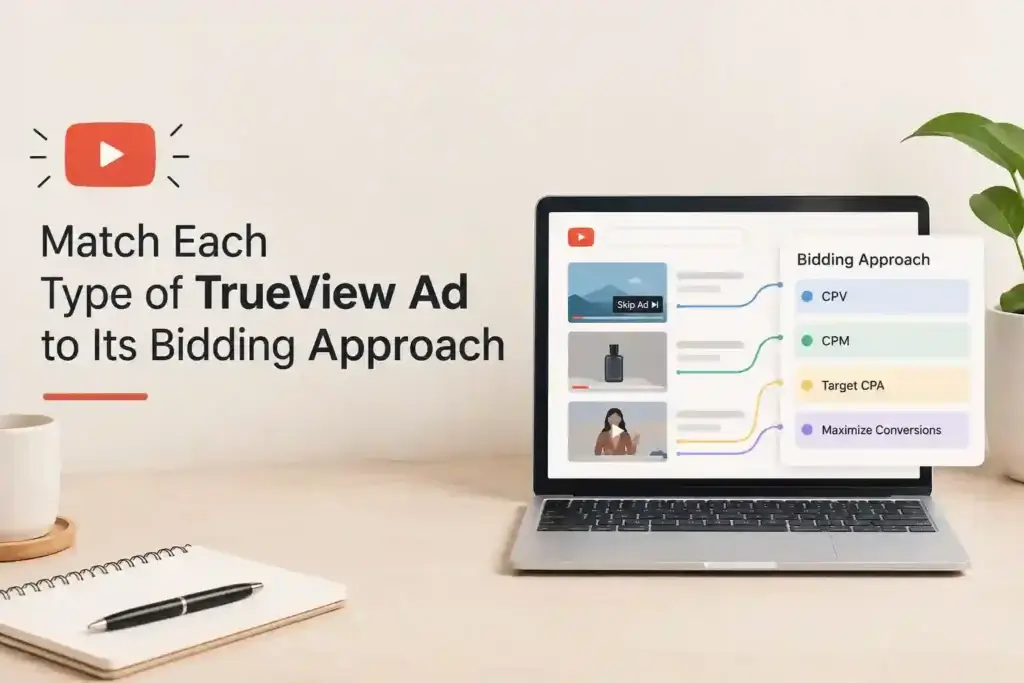
The following table summarizes the traditional learning associations.
| Traditional ad format | Primary marketing objective | Traditional bidding association |
|---|---|---|
| TrueView In-Stream | Video views and consideration | Cost per view (CPV) |
| TrueView Discovery | Video discovery and consideration | Cost per view (CPV) |
| TrueView for Action | Actions and conversions | Target CPA or conversion-focused bidding |
| Bumper ads | Brand awareness | CPM-based bidding |
| Masthead ads | Broad awareness and reach | CPM or reservation-based pricing, depending on the buying arrangement |
These associations are useful for understanding older Google Ads certification questions. However, they should not be treated as a guarantee that every format supports the same bidding options today.
The most important lesson in match each type of trueview ad to its bidding approach is to understand the relationship between the ad format, marketing objective, and bidding strategy.
2. YouTube TrueView In-Stream Ads and CPV Bidding
Traditional TrueView In-Stream ads appear before, during, or after other video content. Viewers can generally skip these advertisements after five seconds.
The traditional bidding association for this format is cost per view (CPV).
With CPV bidding, advertisers set an amount they are willing to pay for a qualifying video view. The actual cost depends on the auction and the applicable billing rules.
For eligible skippable in-stream ads, a view generally counts when someone watches 30 seconds of the advertisement, watches the entire ad if it is shorter than 30 seconds, or interacts with the ad, whichever happens first.
How Does CPV Bidding Work?
Suppose a company creates a 45-second video explaining the features of its new fitness app. The business wants potential customers to watch the video and understand how the app works.
A view-focused campaign may be suitable because the advertiser wants people to engage with the video rather than simply have the advertisement appear on their screens.
When learning match each type of trueview ad to its bidding approach, remember that CPV bidding can be useful when your primary objective is to:
- Increase qualifying video views.
- Introduce a new product or service.
- Build brand or product consideration.
- Test different video messages.
- Understand how audiences engage with video content.
For example, a business may test two versions of a product video. One version could attract more qualifying views, while the other might encourage more website visits. The better version depends on the campaign’s objective.
3. Google Ads TrueView Discovery and In-Feed Video Ads

TrueView Discovery ads were designed to help people discover videos while browsing YouTube. The modern format most closely associated with this experience is generally called an in-feed video ad.
These advertisements can appear in locations such as YouTube search results, suggested videos, and the Home feed, depending on the available placements and campaign settings.
The traditional exam association for TrueView Discovery is CPV bidding, reflecting its emphasis on viewer interest and consideration.
When Should You Use In-Feed Video Ads?
Imagine that an interior design business publishes a video titled “10 Simple Ways to Refresh Your Living Room.”
The company wants people who are interested in home improvement to discover its content. An in-feed video ad may help the business reach viewers who are already exploring related topics.
This format may be useful for:
- Educational videos and tutorials.
- Product demonstrations.
- Content designed to build customer interest.
- Videos that answer common questions.
- Businesses that want people to explore their YouTube channels.
However, interest does not always lead to a sale. Consideration-focused advertising helps build familiarity and interest, which may support later purchasing decisions.
Understanding match each type of trueview ad to its bidding approach also means recognizing that the historical format names may differ from the names used in the current Google Ads interface.
For current format details, read Google’s guide to in-feed video ads.
4. TrueView for Action, CPA Bidding, and Conversion-Focused Advertising
TrueView for Action was a historical video advertising format designed to encourage viewers to complete actions such as purchases, website visits, and lead submissions.
Its traditional bidding associations include Target CPA and other conversion-focused strategies. The main difference between view-focused and conversion-focused advertising is the result the advertiser wants to achieve.
A view-focused campaign emphasizes qualifying video views. A conversion-focused campaign aims to generate valuable actions. In this situation, the advertiser needs appropriate conversion tracking and a campaign that supports the selected bidding strategy.
What Is Cost Per Acquisition?
Cost per acquisition (CPA) measures the advertising cost associated with generating a conversion. Depending on the campaign, that conversion could be a purchase, lead, sign-up, or another valuable action.
Suppose an online store spends $500 on advertising and generates 25 tracked purchases.
The average cost per purchase is calculated as follows:
- [\text{CPA}=\frac{\text{Total advertising spend}}{\text{Number of conversions}}]
- [\text{CPA}=\frac{$500}{25}=$20]
The average cost per purchase is $20.
Whether this result is profitable depends on the product’s profit margin, operating expenses, and customer value. This is why advertisers should evaluate profitability, not just advertising metrics.
Target CPA vs. Maximize Conversions
Target CPA and Maximize conversions are related but different bidding approaches.
- Target CPA: Aims to generate conversions around a specified average acquisition cost.
- Maximize conversions: Aims to generate as many conversions as possible within the available budget, subject to campaign settings and auction opportunities.
Neither strategy guarantees a specific number of sales or a fixed cost per conversion.
For example, a business that has a clear acquisition-cost target may prefer a strategy built around that target. Another business may prioritize increasing the number of tracked conversions within its budget.
The best choice depends on the campaign’s objective, available data, budget, and the bidding options supported by the campaign.
An Important Update to TrueView for Action
Google has upgraded its Video Action Campaigns to Demand Gen campaigns. As a result, advertisers should not assume that the original TrueView for Action setup remains available exactly as it appeared in older tutorials.
The underlying principle remains useful: when the goal is to generate leads or sales, select a current campaign type and bidding strategy that supports the desired conversion objective.
When applying match each type of trueview ad to its bidding approach to modern campaigns, always verify that the campaign supports the bidding option you intend to use.
Read Google’s announcement about the Video Action Campaigns upgrade to Demand Gen.
5. YouTube Bumper Ads and CPM Bidding for Brand Awareness
Bumper ads are short, non-skippable video advertisements traditionally limited to six seconds. They are commonly used to communicate a brief message and increase brand awareness.
The standard learning association is cost per thousand impressions (CPM) or an applicable target CPM strategy.
CPM measures the cost of displaying an advertisement 1,000 times.
Suppose an advertising campaign receives 100,000 impressions at an average CPM of $5. The estimated cost is $500.
- [\text{Cost}=\frac{\text{Impressions}}{1000}\times\text{CPM}]
- [\text{Cost}=\frac{100,000}{1000}\times$5=$500]
At that CPM, the estimated cost is $500. Actual campaign charges depend on the auction and applicable settings.
Why Are Bumper Ads Useful for Awareness?
A short advertisement cannot explain every product feature, but it can reinforce a brand name, introduce an offer, or communicate one memorable benefit.
For example, a coffee company could show its product, logo, and slogan in a short video. Bumper ads may also support a larger marketing campaign that includes longer videos, social media content, and other advertising channels.
This is why bumper ads are commonly associated with awareness rather than being treated as a direct replacement for conversion-focused campaigns.
When studying match each type of trueview ad to its bidding approach, remember that bumper ads are a separate format and should not be confused with traditional TrueView In-Stream ads.
6. Google YouTube Masthead Ads and Broad Brand Awareness

YouTube Masthead ads are prominent advertisements associated with the top area of the YouTube Home feed. They are typically used to create broad exposure for major product launches and awareness campaigns.
Masthead ads are not simply another traditional TrueView format. They have their own buying arrangements, which may include CPM or reservation-based pricing, depending on the available option.
When Are Masthead Ads Useful?
Imagine that an electronics match each type of trueview ad to its bidding approach company is launching a new phone. The marketing team wants to introduce the product to a broad audience over a short period.
A prominent Masthead placement may help the company showcase its launch message to many YouTube users.
This approach differs from a small service business that wants a steady flow of customer inquiries. The electronics company may prioritize reach, while the service business may prioritize conversions.
Advertisers should also consider whether a prominent placement is appropriate for their audience and campaign economics. Broad exposure can be valuable, but it should still serve a clear marketing purpose.
A useful principle in match each type of trueview ad to its bidding approach is to select the format and buying method based on the outcome the business actually needs, not simply on the popularity of the advertising format.
7. Match Each Type of TrueView Ad to Its Bidding Approach: Seven Powerful Tips
The number 7 in the article title refers to seven practical learning points that help advertisers understand and apply the relationship between video ad formats and bidding strategies.
These tips are not seven separate Google Ads bidding types. Instead, they provide a straightforward process for selecting, measuring, and improving a video advertising campaign.
Tip 1: Define Your Primary Marketing Objective
Start by asking one simple question: What do I want this campaign to achieve?
Your answer should guide your decisions about ad format, bidding, audience targeting, and measurement.
For example:
- If you want people to discover your brand, focus on awareness and reach.
- If you want people to watch and explore your video, focus on views and consideration.
- If you want people to submit forms or make purchases, focus on conversions.
- If you want to increase sales revenue, consider whether value-based bidding is appropriate.
Avoid expecting one campaign to achieve every objective equally well. A clear primary goal makes it easier to select suitable settings and measure success.
Tip 2: Choose a Suitable Video Format
Consider how your audience will encounter your message.
- A skippable in-stream ad may be suitable for a product demonstration or explanatory video.
- An in-feed video ad may be relevant when people are browsing or searching for related content.
- A bumper ad may work well for a short, memorable brand message.
- A Masthead placement may be appropriate for a large awareness campaign when the required buying arrangement is available.
The best format depends on the message, audience, budget, and campaign objective.
Tip 3: Select an Eligible Bidding Strategy
Once you have match each type of trueview ad to its bidding approach identified the objective and format, review the eligible bidding options.
- For campaigns focused on video views, CPV bidding may be suitable when available.
- For impression-focused awareness, an appropriate CPM-based strategy may be more relevant.
- For sales and lead generation, consider eligible conversion-focused strategies such as Target CPA or Maximize conversions.
If conversion value is important, investigate whether Target ROAS or another value-based approach is available for your campaign.
Do not select a strategy simply because a competitor uses it. Your objective, measurement setup, and budget should guide the decision.
Tip 4: Set a Realistic Advertising Budget
Your advertising budget determines how much you are prepared to spend over a defined period.
Before launching the campaign, estimate how much you can reasonably invest and what result would make that investment worthwhile. For example, a local service provider might calculate the maximum sustainable cost of acquiring a customer. An online retailer might estimate the profit it earns from an average order.
These figures help you decide whether the campaign is producing commercially useful results.
Tip 5: Configure Conversion Tracking
If match each type of trueview ad to its bidding approach your goal is to generate leads or sales, measure those actions rather than relying only on video views.
Depending on your business and setup, conversion tracking may measure:
- Completed purchases.
- Form submissions.
- Qualified leads.
- Sign-ups.
- Other valuable website or business actions.
Use Google’s conversion tracking guide to understand the available options.
Make sure your chosen conversion actions represent the results you actually want. Tracking a low-value action as the main conversion may encourage the campaign to optimize toward the wrong outcome.
Tip 6: Monitor Campaign Performance
Once the campaign match each type of trueview ad to its bidding approach is running, review the metrics that match your objective.
- For a view-focused campaign, monitor qualifying views, average CPV, view rate, and relevant engagement metrics.
- For an awareness campaign, review impressions, reach, frequency, and other appropriate visibility measures.
- For a conversion-focused campaign, examine conversions, conversion rate, cost per conversion, and conversion value where relevant.
A campaign should not be judged by a single number. A low CPV may look attractive, but it does not necessarily indicate success if the business goal is to generate purchases.
Tip 7: Improve Performance Using Evidence
Understanding the differences between bidding strategies is essential when learning match each type of trueview ad to its bidding approach. After collecting sufficient data, identify areas that need improvement.
You might test a different video opening, clarify the call to action, improve the landing page, or review audience targeting.
Avoid making major changes every few hours. Campaign performance can fluctuate, and frequent adjustments may make it difficult to identify which changes helped. Use the results to make informed improvements rather than relying on guesswork.
Conclusion
Understanding match each type of trueview ad to its bidding approach helps marketers make more informed video advertising decisions.
Traditional TrueView In-Stream and TrueView Discovery formats are commonly associated with CPV bidding because they emphasize qualifying views and viewer engagement. TrueView for Action is associated with Target CPA and conversion-focused bidding because it aims to encourage valuable actions. Bumper ads are commonly associated with CPM-based bidding and awareness, while Masthead ads support prominent brand exposure through their own buying arrangements.
The seven tips in this article provide a practical framework for understanding these relationships. They cover choosing an objective, selecting a format, matching the bidding strategy, setting a budget, configuring conversion tracking, monitoring results, and improving campaign performance.
FAQ’S…
What Does “Match Each Type of TrueView Ad to Its Bidding Approach” Mean?
The phrase match each type of trueview ad to its bidding approach means connecting traditional TrueView ad formats with the bidding methods commonly associated with their marketing objectives.
What are the different types of bidding strategies available in Google Ads?
Google Ads offers several bidding strategies, including Target CPA, Maximize Conversions, Target ROAS, Maximize Conversion Value, and Manual CPC. Video campaigns may also support CPV or CPM-based options. To match each type of trueview ad to its bidding approach, choose a strategy that aligns with your campaign goal and current Google Ads settings.
What are two types of value-based Smart Bidding strategies?
Target ROAS aims to achieve a desired return on ad spend, while Maximize Conversion Value seeks to generate the highest total conversion value within your budget. Understanding these strategies helps match each type of trueview ad to its bidding approach when value-based bidding is supported.
What is the most effective bidding strategy for Google Ads?
The most effective bidding strategy depends on your campaign objective, budget, and tracking data. Target CPA may suit lead generation, while Target ROAS can support revenue-focused campaigns. To match each type of trueview ad to its bidding approach, first decide whether your priority is views, awareness, leads, or sales.
Which bidding strategy is best for maximizing conversions in Google Ads?
Maximize Conversions is designed to generate as many conversions as possible within your campaign budget. Ensure conversion tracking is configured correctly before using it. When you match each type of trueview ad to its bidding approach, select this strategy only if it is available and suitable for your current campaign type.
What’s the best bidding strategy?
There is no single best bidding strategy for every advertiser. CPV may suit view-focused video campaigns, CPM-based bidding may support awareness, and conversion-focused Smart Bidding may help generate leads or sales. To match each type of trueview ad to its bidding approach, consider your primary goal and the options available in Google Ads.
What are two bidding strategies?
Two common Google Ads bidding strategies are Maximize Conversions and Target CPA. Maximize Conversions aims to increase the number of conversions within your budget, while Target CPA focuses on an average acquisition-cost goal. These examples can help you match each type of trueview ad to its bidding approach according to your campaign objectives.