
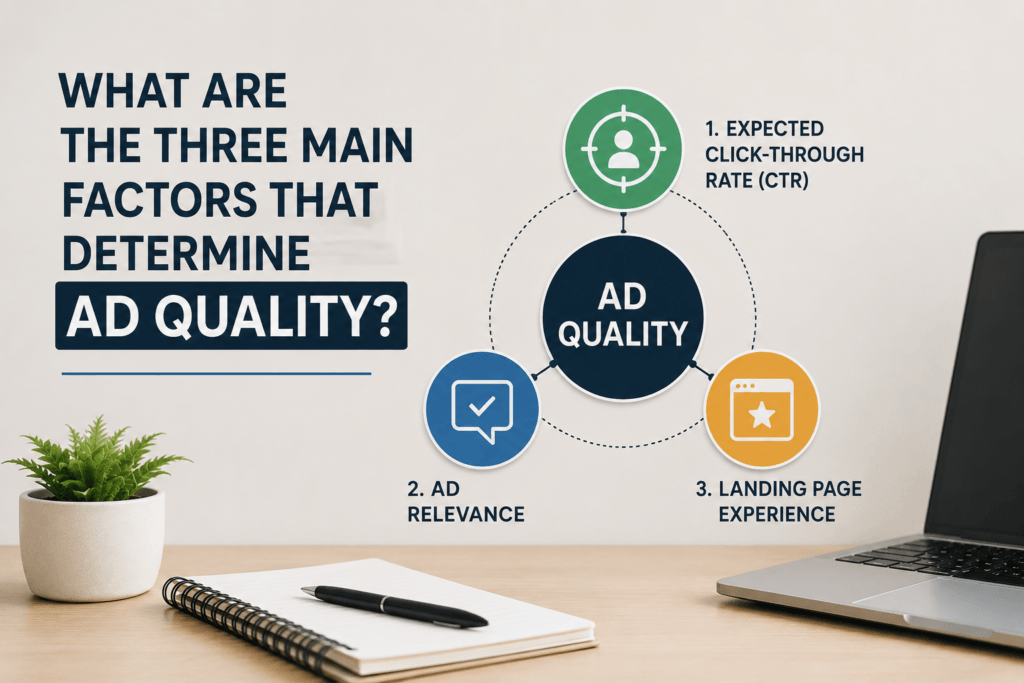
If you are running Google Ads, you may wonder, what are the three main factors that determine ad quality and why they matter for campaign performance. Ad quality plays an important role in creating a useful connection between what people search for, the advertisement they see, and the page they visit after clicking.
For Google Search campaigns, the three main components associated with Quality Score are Expected Click-Through Rate (CTR), Ad Relevance, and Landing Page Experience. Google evaluates these components to help advertisers understand where their keywords, ads, and landing pages may need improvement.
It is important to understand one distinction from the beginning: Quality Score is a diagnostic tool, not an auction input or a standalone performance KPI. Google measures it from 1 to 10 at the keyword level so advertisers can identify opportunities to improve the quality of their advertising experience.
Understanding these three factors gives advertisers a practical way to improve their campaigns. Instead of simply increasing bids or adding more keywords, you can examine what users expect, what your advertisement communicates, and what happens after the click.
Google Ads Quality Score: What Does It Really Mean?
Google Ads Quality Score is a diagnostic measure that helps advertisers understand how their ad quality compares with other advertisers competing for similar searches. It is measured on a 1–10 scale at the keyword level. A higher score indicates that the ad and landing page are considered more relevant and useful compared with other advertisers for that keyword.
You can learn more about Google Ads Quality Score and how it is calculated from Google’s official documentation.
However, advertisers should not treat a Quality Score of 10 as the ultimate campaign objective. The number itself does not tell you whether your campaign is profitable or whether your business is generating enough leads or sales.
For example, a keyword might have a strong Quality Score but still produce few conversions because the offer is weak, the targeting is wrong, or the landing page does not persuade visitors to take action. This is why Google recommends using Quality Score together with other performance indicators such as CTR, conversion rate, and site engagement.
Think of Quality Score as a diagnostic warning light. It can tell you where to investigate, but you still need to look at the wider campaign and business results.
Expected Click-Through Rate (CTR): How Likely Are Users to Click?
Expected Click-Through Rate (CTR) is the first major factor that determines Quality Score. It represents the likelihood that someone will click your ad when it is shown for a particular search.
Imagine that someone searches for “affordable accounting services.” They see one generic advertisement that simply says “Accounting Services” and another advertisement that clearly communicates a relevant service and benefit. The second advertisement may give the searcher a stronger reason to click because it appears more closely connected to what they are looking for.
This is why ad copy, keyword intent, and your value proposition all matter. Your advertisement needs to explain what you offer without making misleading promises.
A strong CTR strategy is not about attracting as many clicks as possible. It is about attracting the right clicks. An advertisement that receives many irrelevant clicks can waste your advertising budget and send visitors who have little interest in your offer.
Google’s official guidance on improving Quality Score recommends making ad text more compelling and ensuring that the details in the advertisement match the intent behind the keywords.
For example, instead of using a vague message such as “Professional Marketing Services,” a business could create more specific messaging around the service a searcher is actually looking for. When the advertisement clearly communicates the solution, the right audience has a better reason to click.
This is where search intent becomes especially important. Before writing your ad, ask yourself what the person wants to accomplish with the search. Someone searching for “SEO audit service” has a different intention from someone searching for “what is an SEO audit.” Matching your ad message to that intent can make the advertisement more useful and relevant.
Ad Relevance: The Second Main Factor in Ad Quality
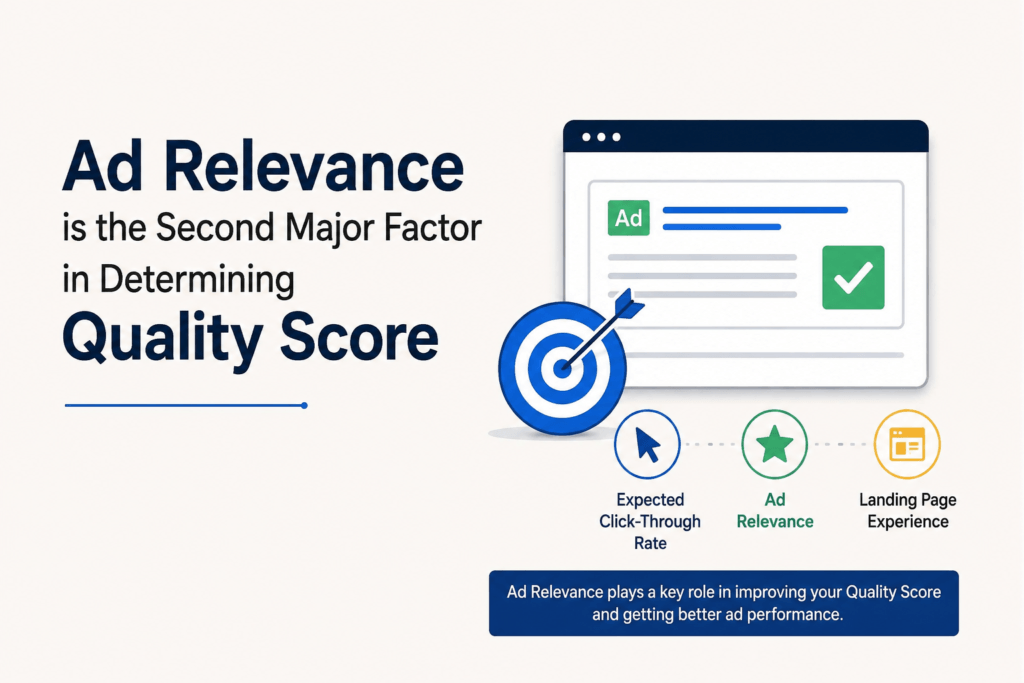
It measures how closely your advertisement matches the intent behind a user’s search.
This sounds straightforward, but it is an area where advertisers frequently make mistakes. A campaign may contain relevant keywords while the advertisements themselves are still too broad to address the actual search.
Imagine a home improvement company that offers kitchen remodeling, bathroom remodeling, flooring, and roofing. If all these keywords are placed into one broad ad group, it becomes difficult to create one advertisement that naturally speaks to every search.
A better approach is to organize related keywords around clear keyword themes and create focused ad groups. This makes it easier to write advertisements that directly address what people are searching for.
Google recommends matching the language of ad text more closely to user searches and separating different keyword themes into more focused ad groups when necessary. Its Quality Score optimization guide provides specific recommendations for improving Ad Relevance.
The goal is not to insert the keyword into every sentence. Instead, the advertisement should make sense as a complete message.
For example, if someone searches for “modern kitchen cabinets,” an advertisement specifically discussing modern kitchen cabinets is likely to feel more relevant than a generic advertisement for home improvement.
This creates a stronger relationship between keywords, ad copy, and search intent. When users immediately recognize that your advertisement relates to their query, they have a clearer reason to continue.
Landing Page Experience: What Happens After the Click?
Landing Page Experience is the third major factor that determines Quality Score. It considers how relevant and useful the landing page is to people who click the advertisement.
Getting someone to click your advertisement is only half of the journey. After the click, your website needs to deliver the experience that the advertisement created in the user’s mind.
Suppose your ad promotes “20% Off Kitchen Cabinets.” A person clicks because they are interested in the offer. If they arrive on a generic home page and cannot find the discount or the relevant products, the experience becomes confusing.
A strong landing page should make the next step clear. The content should relate to the search, the page should be easy to navigate, and the messaging should remain consistent with the advertisement.
Google’s landing page guidance explains that landing page experience includes factors such as the usefulness and relevance of information, ease of navigation, and the expectations created by the advertisement.
Google also recommends making landing pages mobile-friendly, easy to navigate, and useful to visitors. Its official guide to optimizing ads and landing pages provides practical recommendations for improving the post-click experience.
A visitor who searches for a specific product should be able to find that product easily. Someone looking for a service should quickly understand what the service provides. If an advertisement promotes a special offer, the landing page should make that offer clear.
Search Intent and Ad Quality: Why Relevance Matters
Search intent connects all three components of ad quality. It influences what users expect to see, what advertisement is likely to attract their attention, and what information they need after clicking.
Think of the user’s journey as a conversation. The search query is the question. Your advertisement is the response that encourages the user to continue. Your landing page is where you provide the complete solution.
If these three stages do not connect, the experience feels disconnected.
For example, someone searching for “buy office furniture online” has a strong commercial intention. They may expect products, prices, availability, and a straightforward purchasing option. Sending that person to a general educational article may not satisfy their expectations.
On the other hand, someone searching for “best office furniture for small spaces” may still be researching. A helpful guide, comparison, or educational page may be more suitable.
Therefore, understanding user intent before creating your campaign can help you choose better keywords, write more relevant advertisements, and create more useful landing pages.
Ad Copy Optimization: How to Improve Your Advertisements
Ad copy optimization should focus on clarity, relevance, and usefulness rather than simply adding keywords. Your advertisement should communicate what you offer and why it is relevant to the person searching.
Start by reviewing your target keywords and asking whether your headlines and descriptions genuinely address them. If a keyword is highly specific but your advertisement is extremely generic, there may be a disconnect.
Next, communicate a meaningful benefit. Depending on your business, this could be a product feature, service advantage, price, availability, offer, or another legitimate reason for someone to choose your business.
Your call to action should also match the next step you want the visitor to take. If your landing page is designed for purchases, the advertisement should encourage an appropriate purchasing action. If the goal is lead generation, the message could encourage visitors to request information, book a consultation, or get a quote.
Google’s ad and landing page optimization recommendations specifically encourage advertisers to create relevant, compelling ad text, use clear calls to action, and make sure advertisements accurately describe what the business offers.
Landing Page Optimization: Turn Relevant Clicks Into Better Experiences

Landing page optimization is about making the post-click experience useful and straightforward.
First, make sure the page clearly connects to the advertisement. Visitors should not need to search through several pages to determine whether they have reached the right destination.
Second, make important information easy to find. If visitors need to understand a service, explain it clearly. If they need to purchase a product, make product information and purchasing options easy to access.
Third, consider the experience on mobile devices. Google recommends keeping mobile landing pages quick, easy to navigate, and simple for customers to use.
Finally, review whether the page supports your actual business objective. A page can attract visitors and still fail to generate meaningful results if the content does not help them take the next logical step.
Google also provides guidance for evaluating landing page performance, including checking mobile optimization and understanding how visitors interact with the pages receiving advertising traffic.
Quality Score vs. Ad Rank: What Is the Difference?
One common misconception is that Quality Score itself is an input in the Google Ads auction. It is not. Google describes Quality Score as a diagnostic tool rather than an auction input.
However, auction-time quality signals related to factors such as expected CTR, ad relevance, and landing page experience can contribute to Ad Rank. Ad Rank also considers other factors, including the bid and auction context.
You can read Google’s official explanation of Ad Rank to understand how ad quality and bidding work together during the auction.
This distinction matters because advertisers sometimes focus too heavily on achieving a particular Quality Score number. Instead, the better strategy is to improve the actual quality signals and the user experience behind them.
Similarly, increasing your bid does not directly improve your Quality Score assessment. Bidding can influence Ad Rank, but Quality Score remains a diagnostic measurement of ad and landing page quality.
How to Improve All Three Factors Step by Step
What Are the Three Main Factors That Determine Ad Quality in Google Ads? Improving ad quality does not require changing your entire Google Ads account at once. A structured review can make the process much easier.
Start by checking your Quality Score and its three component statuses at the keyword level. Google reports each component as “Above average,” “Average,” or “Below average,” giving you an indication of where improvement may be useful.
If Expected CTR is weak, review your ad messaging. Ask whether the advertisement communicates a clear benefit and whether it matches the intent behind the keyword.
If Ad Relevance is weak, examine your keyword organization and ad copy. You may have different search intentions grouped together, making it difficult for one advertisement to address them naturally.
If Landing Page Experience is weak, review the destination page. Check whether the content matches the advertisement, whether the information is useful, whether navigation is simple, and whether the page works effectively on mobile devices.
After making changes, do not judge the campaign only by Quality Score. Also monitor CTR, conversion rate, site engagement, and actual business outcomes. Google’s Quality Score performance guide recommends using Quality Score alongside other performance metrics rather than treating it as a standalone campaign goal.
Common Mistakes That Can Lower Ad Quality
One common mistake is creating advertisements that are too general. A broad message may technically relate to a business but fail to address the specific reason behind a user’s search.
Another mistake is sending every visitor to the same generic landing page. Different searches often represent different needs, so creating more relevant landing experiences can make the customer journey clearer.
Keyword stuffing is another poor approach. Adding keywords repeatedly does not automatically make an advertisement more relevant. The copy still needs to sound natural and communicate a useful message.
Advertisers should also avoid chasing Quality Score as if it were the only measure of success. A campaign exists to achieve a business objective, whether that means generating qualified leads, selling products, receiving enquiries, or increasing profitable conversions.
Why Ad Quality Matters for Your Google Ads Campaign
what are the three main factors that determine ad quality High-quality advertising creates a stronger connection between what people search for, what they see in the advertisement, and what they experience after clicking.
Google explains that Ad Rank incorporates auction-time ad quality along with factors such as bids, thresholds, and the context of the search. Improving ad and landing page quality can therefore contribute to stronger opportunities in the auction.
That is why ad quality optimization is more than a technical Google Ads task. It is fundamentally about understanding your audience and delivering a consistent experience.
When your keywords are well organized, your advertisements are relevant, and your landing pages provide what visitors expect, your campaign has a stronger foundation for attracting the right users.
What Are the Three Main Factors That Determine Ad Quality? Final Answer
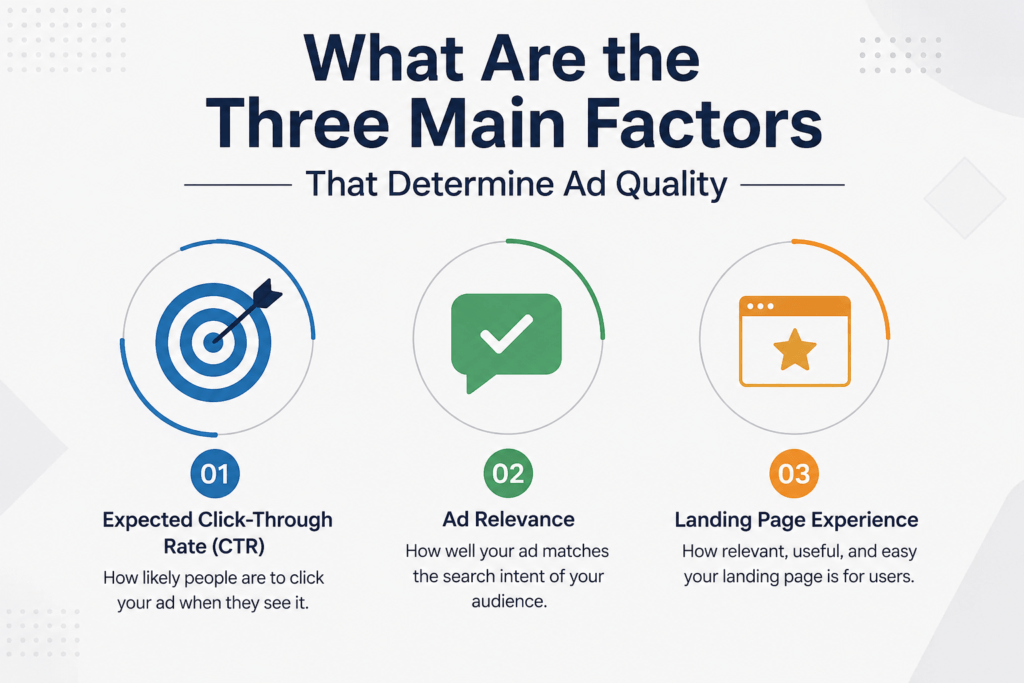
So, what are the three main factors that determine ad quality? The answer is Expected Click-Through Rate (CTR), Ad Relevance, and Landing Page Experience.
Expected CTR focuses on how likely people are to click your advertisement. Ad Relevance looks at how closely your advertisement matches the intent behind their search. Landing Page Experience considers whether the page provides a relevant and useful experience after the click.
These three areas work together. A highly relevant keyword will not help much if the advertisement is unappealing. A compelling advertisement will not deliver the best experience if the landing page is unrelated. And a strong landing page cannot compensate for an advertisement that does not attract the right audience.
The smartest approach is therefore to look at the complete journey—from keyword and search intent to ad copy, click, landing page, and conversion. Use Quality Score as a diagnostic tool, identify the weakest areas, and make improvements that genuinely help your audience.
If you want your Google Ads campaigns to perform more effectively, focus less on chasing a perfect score and more on creating advertisements and landing pages that give users exactly what they are looking for.
Conclusion
Understanding what are the three main factors that determine ad quality is essential for creating more relevant and effective Google Ads campaigns. The three key factors—Expected CTR, Ad Relevance, and Landing Page Experience—work together to connect a user’s search, your advertisement, and the page they visit.
Rather than focusing only on achieving a high Quality Score, review the complete customer journey. Make your ads relevant to search intent, organize keywords around clear themes, and ensure your landing pages provide the information users expect. By improving these areas, you can create a better advertising experience and build a stronger foundation for meaningful campaign results.
FAQ’S…
What are the 5 basic factors of advertising?
The five basic factors of advertising are the target audience, advertising objective, message, media channel, and budget. These elements help businesses create focused campaigns. Understanding what are the three main factors that determine ad quality—Expected CTR, Ad Relevance, and Landing Page Experience—is also important for Google Ads performance.
What factors are essential in making a good advertisement?
A good advertisement should have a clear message, relevant content, an appealing value proposition, strong targeting, and a suitable call to action. In Google Ads, what are the three main factors that determine ad quality is answered by Expected CTR, Ad Relevance, and Landing Page Experience.
What is the most important factor in an advertisement?
Relevance is one of the most important factors because an advertisement should match the audience’s needs and search intent. For Google Ads, what are the three main factors that determine ad quality includes Expected CTR, Ad Relevance, and Landing Page Experience.
What are the qualities of good advertising?
Good advertising is clear, relevant, credible, engaging, audience-focused, and actionable. It should communicate a meaningful benefit without misleading users. For Google Ads, understanding what are the three main factors that determine ad quality helps advertisers focus on Expected CTR, Ad Relevance, and Landing Page Experience.