
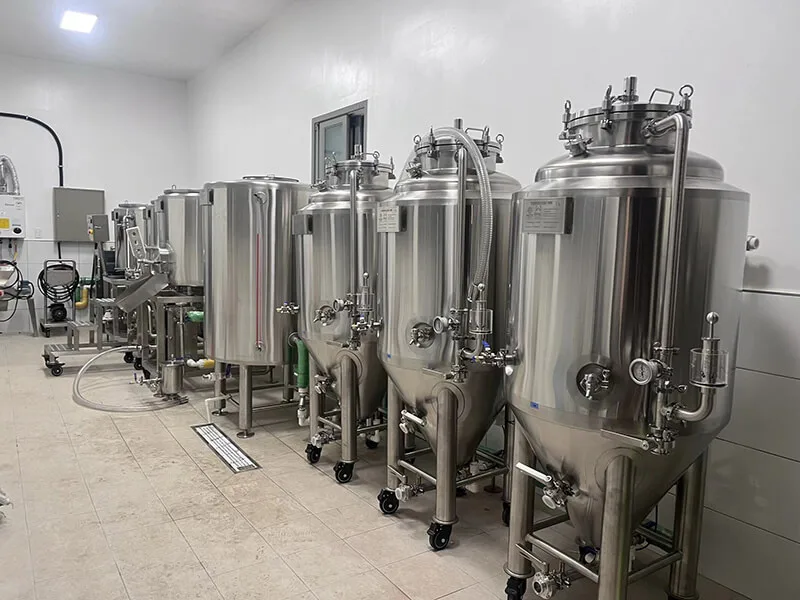
Choosing the right fermentation tank for a craft brewery requires more than comparing tank sizes or purchase prices. A brewery fermentation tank must match the beer styles being produced, batch volume, fermentation schedule, cooling requirements, cleaning process, available utilities, and future production plans.
A well-designed fermentation tank for a craft brewery system gives brewers better control over temperature, pressure, yeast management, fermentation time, sanitation, and beer transfers. It should also provide enough headspace for fermentation activity while allowing efficient yeast and trub removal and low-oxygen beer transfer.
Breweries evaluating brewery equipment should define their process requirements before requesting quotations. Comparing suppliers against the same specification makes it easier to evaluate vessel design, operating costs, automation, maintenance requirements, and long-term value.
What Is a Fermentation Tank Used for in a Brewery?
A fermentation tank for a craft brewery is the vessel where yeast converts fermentable sugars in wort into alcohol, carbon dioxide, and other compounds that influence the beer’s flavor and character.
In many craft breweries, stainless steel conical fermenters are preferred because their geometry supports fermentation, yeast collection, trub removal, temperature control, and beer transfer.
Before selecting a tank, define what the vessel must accomplish.
Consider:
- Beer styles being produced
- Original gravity and final gravity
- Fermentation temperature
- Required fermentation time
- Batch size
- Yeast management requirements
- Dry-hopping process
- Carbonation or pressure requirements
- Beer transfer method
- Cleaning and sanitation process
- Expected production frequency
The fermentation tank for a craft brewery should be selected around the complete brewing process rather than a single specification such as gross volume.
How Do You Calculate Fermentation Tank Capacity?
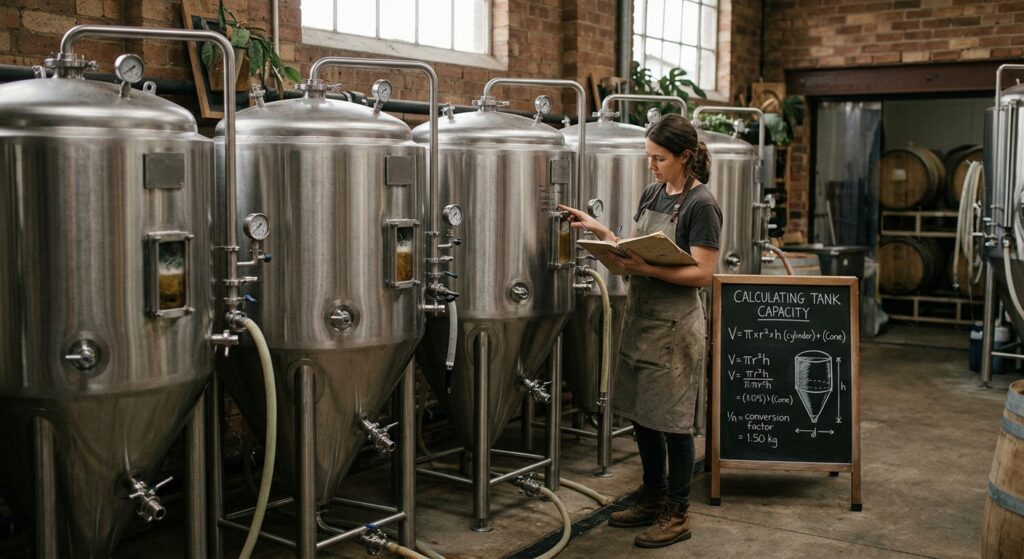
fermentation tank for a craft brewery should be based on usable working volume rather than the vessel’s total or gross volume.
A tank needs sufficient headspace above the wort or beer to accommodate fermentation activity, foam, krausen, and pressure changes. Filling a vessel to its maximum physical capacity can create operational and quality problems.
When calculating capacity, consider:
- Knockout volume
- Working volume
- Headspace
- Foam and krausen
- Trub losses
- Yeast losses
- Transfer losses
- Cleaning turnaround time
- Fermentation duration
- Number of brews required per tank
- Expected annual production
For example, if several brews are needed to fill a fermenter, the fermentation tank for a craft brewery schedule must be coordinated with the brewhouse output and available tank space.
Capacity should therefore be evaluated against the entire cellar workflow, not just the supplier’s stated tank volume.
What Is the Difference Between Gross Volume and Working Volume?
Gross volume describes the physical capacity of the vessel, while working volume represents the practical amount of beer or wort that can be processed safely.
This distinction is particularly important when comparing fermentation tank for a craft brewery from different manufacturers.
A tank with a larger advertised capacity may not provide more usable fermentation volume if a significant portion is reserved for headspace.
Ask suppliers to specify:
- Total vessel volume
- Recommended working volume
- Minimum working volume
- Maximum fill level
- Headspace percentage
- Maximum operating pressure
These figures provide a more meaningful comparison than nominal fermentation tank for a craft brewery capacity alone.
Which Fermentation Tank Design Features Matter Most?
The mechanical design of a conical fermentation tank for a craft brewery directly affects fermentation, cleaning, maintenance, and beer handling.
Important features include:
- Cone angle
- Vessel diameter and height
- Cooling jacket coverage
- Pressure rating
- Manway size and location
- Racking arm
- Sample valve
- Bottom outlet
- Yeast collection port
- Dry-hop port
- CIP spray device
- Insulation
- Temperature sensors
- Pressure gauge
- Safety relief devices
The fermentation tank for a craft brewery cone should support efficient collection of yeast and sediment while allowing beer to be transferred without unnecessarily disturbing settled material.
Access is equally important. Valves, fittings, sensors, seals, and ports should be positioned so operators can inspect, clean, replace, and maintain them safely.
A feature that looks useful on a specification sheet can become a production problem if it is difficult to access or clean.
How Important Is the Cooling System?
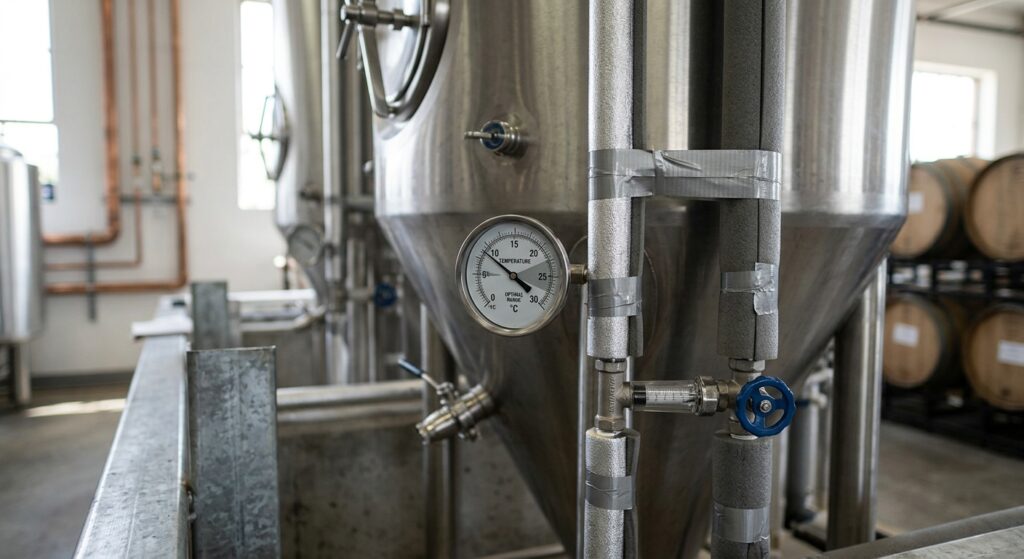
Temperature control is one of the most important functions of a brewery fermentation tank for a craft brewery.
Fermentation generates heat, so the fermentation tank for a craft brewery needs a reliable method of removing that heat and maintaining the required fermentation temperature. Many commercial fermenters use glycol cooling jackets connected to a chilled glycol system.
Evaluate:
- Cooling jacket coverage
- Glycol supply temperature
- Glycol flow rate
- Heat-transfer requirements
- Insulation
- Temperature sensor location
- Control response
- Simultaneous cooling demand
Cooling capacity should be calculated using the brewery’s actual production schedule.
If multiple fermenters require cooling at the same time, the glycol system must be able to handle the combined peak demand.
Undersized cooling can affect fermentation consistency, while excessive system capacity may increase installation and operating costs without providing practical benefits.
What Pressure Rating Should a Fermentation Tank Have?
If the fermentation tank for a craft brewery brewery plans to ferment or store beer under pressure, the vessel’s pressure rating becomes a critical specification.
Pressure requirements depend on the intended process and should be established before purchasing the tank.
Review:
- Maximum working pressure
- Pressure relief protection
- Vacuum protection
- Pressure gauge
- Safety valves
- Carbonation requirements
- Pressure-transfer requirements
- Applicable design and safety standards
Never assume that a standard atmospheric fermenter can safely perform pressure-rated operations.
The supplier should clearly identify the vessel’s allowable operating conditions and provide the relevant documentation for the selected design.
What Utilities Does a Fermentation Tank Need?
A fermentation tank for a craft brewery system requires more than the tank itself. The brewery must provide the utilities and connections needed for normal operation and cleaning.
Typical requirements include:
- Glycol supply and return
- Electrical power
- Control-panel connections
- Compressed gas
- CO₂ supply
- Water
- Drainage
- CIP connections
- Venting
- Pressure-relief discharge arrangements
For each utility, document the required flow rate, pressure, temperature, electrical load, connection size, and peak demand.
Also identify which utilities are included with the equipment package and which must be provided by the brewery.
This prevents unexpected installation costs and commissioning delays.
How Much Automation Does a Brewery Fermenter Need?
Automation should improve consistency without making basic operation unnecessarily complicated.
A practical fermentation control system may include:
- Digital temperature measurement
- Temperature control
- Pressure monitoring
- Cooling control
- High- and low-temperature alarms
- Pressure alarms
- Data logging
- Manual operating modes
- Safety interlocks
For larger breweries, automation can integrate fermenters with a central control system and production monitoring platform.
However, the appropriate level of automation depends on brewery size, production volume, staffing, process complexity, and budget.
The key question is not how many automated features a tank has, but whether those features improve process control, repeatability, safety, and operator efficiency.
How Should a Fermentation Tank Be Cleaned?
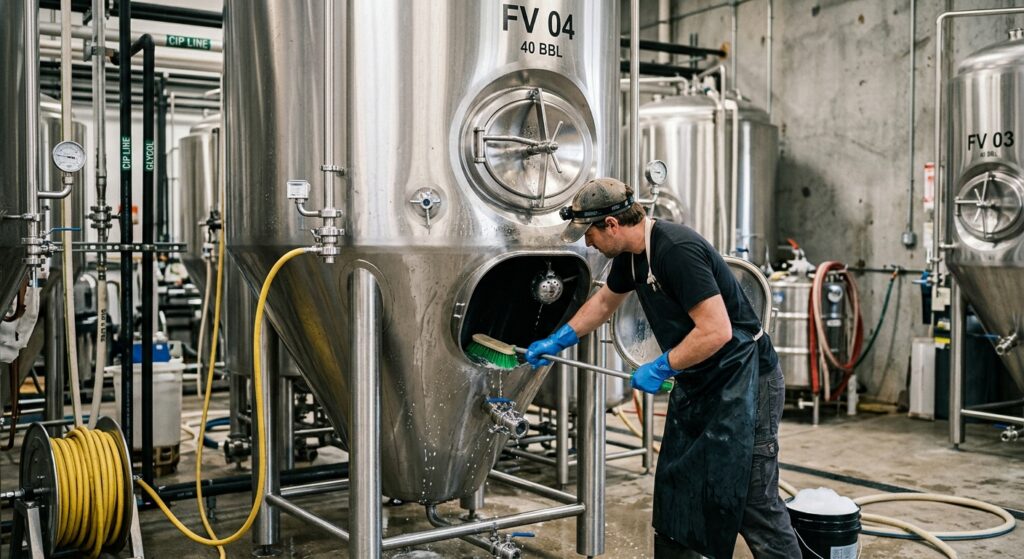
Sanitation is essential in brewing because contamination can negatively affect fermentation and beer quality.
The tank should support an effective clean-in-place (CIP) process and allow cleaning chemicals to reach all product-contact surfaces.
Evaluate:
- CIP spray-ball or rotary spray device
- Internal surface finish
- Drainability
- Valve design
- Product-contact piping
- Dead-leg control
- Cleaning chemical compatibility
- Cleaning temperature
- Cleaning flow rate
- CIP return conditions
The vessel should drain completely without leaving areas where beer, yeast, cleaning solution, or other material can accumulate.
Map the complete product-contact path from wort inlet through the fermenter, outlet, valves, transfer lines, and drain.
A tank that is difficult to clean can increase labor, water, chemical consumption, downtime, and contamination risk.
How Does the Fermenter Connect to the Brewery?
The fermentation vessel should integrate with the brewhouse, cellar, yeast-handling equipment, bright beer tanks, and packaging system.
Review:
- Wort transfer line
- Pump capacity
- Hose and pipe sizing
- Tank outlet configuration
- Racking arm position
- Yeast collection system
- Dry-hop equipment
- Bright tank connections
- Packaging schedule
- Pipe elevations
- Valve arrangement
Check whether the downstream system can accept beer at the required transfer rate.
A fermenter may have the correct capacity but still create bottlenecks if transfer lines, pumps, bright tanks, or packaging equipment cannot keep pace.
How Does Yeast and Trub Removal Affect Tank Selection?
One advantage of a conical fermenter is the ability to collect yeast and trub at the bottom of the vessel.
When comparing tanks, evaluate the cone design, bottom outlet, yeast collection arrangement, and valve configuration.
The system should allow operators to remove sediment without unnecessarily disturbing the finished beer.
If yeast is being harvested for reuse, also consider:
- Yeast collection volume
- Collection frequency
- Sanitary connections
- Storage requirements
- Cleaning procedure
- Yeast transfer method
Good yeast-management design can improve consistency and reduce waste in breweries that routinely repitch yeast.
What Common Fermentation Tank Specification Mistakes Should You Avoid?
Several purchasing mistakes can create long-term operational problems.
Common examples include:
- Buying based only on gross tank volume
- Ignoring fermentation headspace
- Undersizing glycol capacity
- Choosing an unsuitable pressure rating
- Ignoring minimum working volume
- Poor valve or port placement
- Insufficient CIP coverage
- Inadequate drainage
- Difficult maintenance access
- Forgetting future production requirements
- Comparing suppliers only by purchase price
Small omissions in fittings, instrumentation, utility connections, insulation, or access can become permanent costs after installation.
Evaluate the complete lifecycle cost, including installation, utilities, cleaning, maintenance, spare parts, downtime, and future expansion.
How Should Fermentation Tank Performance Be Tested?
Performance requirements should be agreed upon before fabrication or shipment.
Depending on the project, verification may include:
- Vessel dimensions
- Material documentation
- Weld quality
- Internal surface finish
- Pressure testing
- Jacket integrity
- Temperature-control performance
- CIP spray coverage
- Drainage
- Instrument calibration
- Control-system operation
- Safety-device operation
- Fermentation performance
Separate factory acceptance testing from site acceptance testing.
Use measurable criteria rather than general statements such as “good performance.”
Document test conditions, tolerances, responsibilities, corrective actions, and the evidence required for final acceptance.
What Is the Best Process for Choosing a Fermentation Tank?
A structured selection process reduces mistakes and makes supplier comparisons easier.
- Define the beer portfolio: List beer styles, recipes, batch sizes, fermentation temperatures, and production targets.
- Calculate working capacity: Account for headspace, losses, fermentation time, and tank turnover.
- Map the production flow: Connect brewhouse output with fermentation, yeast handling, bright beer storage, and packaging.
- Define utilities: Calculate glycol, electrical, water, gas, drainage, and CIP requirements.
- Select vessel features: Specify cone geometry, ports, valves, cooling jackets, insulation, sensors, and pressure requirements.
- Define automation: Decide which controls, alarms, monitoring, and data functions are actually required.
- Review installation requirements: Confirm floor space, access, piping, electrical connections, and maintenance clearance.
- Set acceptance criteria: Define factory, site, and product testing before the equipment is purchased.
- Compare lifecycle value: Evaluate purchase price together with operating, cleaning, maintenance, and expansion costs.
What Information Should You Include in a Fermentation Tank RFQ?
A detailed request for quotation allows suppliers to provide comparable proposals.
Include:
- Beer styles
- Recipes and wort characteristics
- Batch size
- Annual production volume
- Fermentation time
- Required tank quantity
- Working and gross volume
- Headspace requirements
- Fermentation temperature range
- Pressure requirements
- Cooling method
- Glycol conditions
- CIP method
- Automation requirements
- Utility availability
- Facility layout
- Applicable standards
- Delivery requirements
- Installation scope
- Commissioning requirements
- Acceptance testing
A supplier of fermentation tanks for a craft brewery should also receive a clear definition of what is included in the equipment package.
Ask for separate details covering equipment, installation, commissioning, training, spare parts, documentation, warranty, service, and lead time.
This makes it easier to compare the actual value of different proposals.
How Should You Plan for Future Brewery Expansion?
Future expansion should influence the initial tank selection without automatically leading to oversized equipment.
Consider reserving:
- Floor space
- Glycol capacity
- Electrical capacity
- Control-panel space
- Utility connections
- Pipe routes
- Drainage capacity
- Maintenance access
If production is expected to increase, modular expansion may be more practical than purchasing oversized tanks from the beginning.
Oversized vessels can also create operating problems when the brewery frequently produces small batches.
Define the expected operating range and choose equipment that performs efficiently across the brewery’s realistic production volumes.
Which Documents Should Come With the Fermentation Tank?
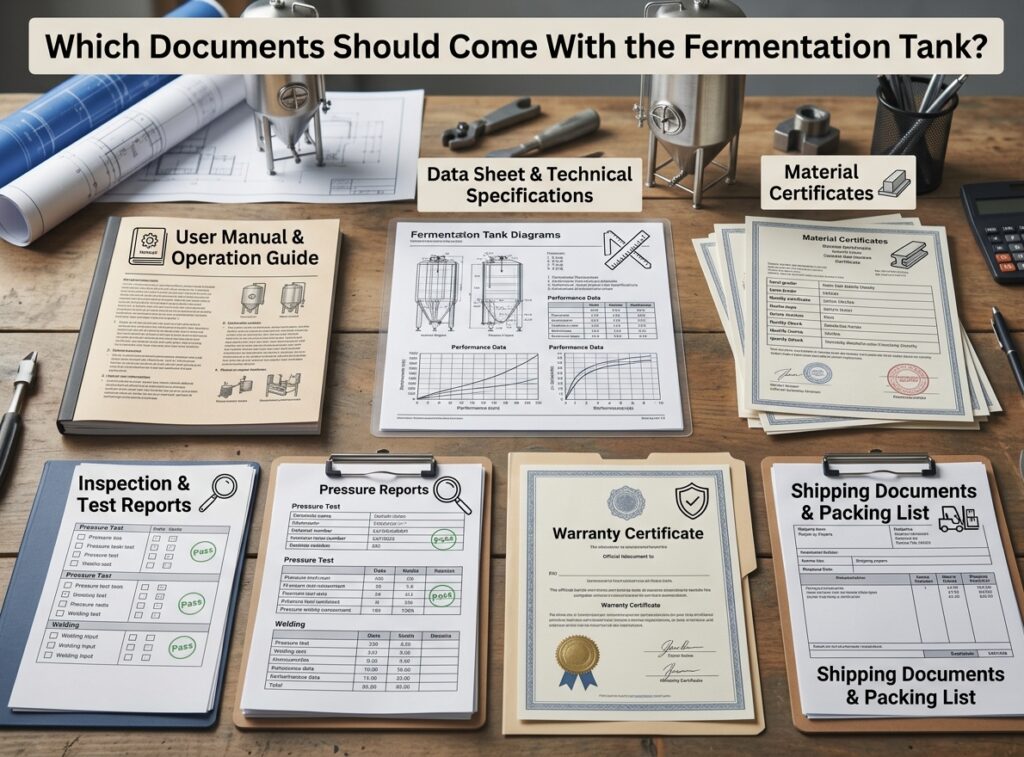
fermentation tank for a craft brewery Complete documentation is important for installation, operation, maintenance, and future troubleshooting.
Request:
- Approved engineering drawings
- Vessel specifications
- Product-contact material records
- Component datasheets
- Utility requirements
- Piping information
- Electrical documentation
- Control-system descriptions
- Calibration records
- Pressure-test documentation
- CIP guidance
- Maintenance instructions
- Spare-parts lists
- Warranty information
- Factory acceptance test results
Document revisions should correspond to the equipment actually delivered.
Operators should also be able to identify every major valve, instrument, alarm, control setting, service point, and safe isolation location.
Final Thoughts
Choosing the right fermentation tank for a craft brewery requires a process-focused approach. The ideal tank is not necessarily the largest or least expensive option. It is the vessel that matches the brewery’s production volume, beer styles, fermentation requirements, cooling system, cleaning process, utilities, automation strategy, and future plans.
Focus on working volume, headspace, temperature control, pressure capability, sanitary design, yeast management, CIP performance, maintenance access, and system integration.
Before purchasing, provide suppliers with a detailed specification and compare complete lifecycle requirements rather than relying on headline capacity or equipment price.
A properly selected fermentation tank can provide more consistent fermentation, easier cleaning, safer operation, predictable production capacity, and a more reliable path for future brewery growth.
FAQ’S…
How much do brewery tanks cost?
The cost of a fermentation tank for a craft brewery depends on its capacity, stainless-steel grade, pressure rating, cooling jacket design, automation, and included fittings. Small tanks generally cost less, while larger custom vessels with advanced temperature control and automation require a higher investment.
What are the tanks called at breweries?
Breweries use several types of tanks, including fermentation tanks for a craft brewery, bright beer tanks, brite tanks, conditioning tanks, serving tanks, and storage vessels. Each tank has a specific role in fermentation, maturation, carbonation, storage, or packaging.
What is a fermentation tank called?
A fermentation tank is commonly called a fermenter, fermentation vessel, or conical fermenter. A fermentation tank for a craft brewery is typically designed with temperature control, sanitary fittings, a conical bottom, and suitable ports for yeast collection and beer transfer.
How long can beer sit in a fermenter?
Beer can remain in a fermenter for different periods depending on the beer style, yeast, fermentation conditions, and brewing process. A fermentation tank for a craft brewery should maintain stable temperature and sanitary conditions throughout fermentation, conditioning, and any planned maturation period.