
Running ads for a local service business can feel simple at first. You create an ad, choose your service area, set a budget, and wait for enquiries. But there is a major gap between getting a lead and getting a customer to actually book.
That gap is where many local businesses lose opportunities.
An automated booking system meta ads local service business strategy connects your Meta advertising campaign with a booking process that makes it easy for prospects to choose a service and schedule a suitable time. Instead of relying entirely on someone to call every lead back, the system can move an interested prospect toward an appointment while their interest is still fresh.
For contractors, cleaners, electricians, plumbers, landscapers, roofers, HVAC companies, salons, consultants, and other appointment-based businesses, this can make the advertising journey much more efficient.
Meta’s lead-generation ecosystem has also been moving toward reducing friction between lead submission and appointment scheduling. The source material provided for this article describes an in-app appointment flow in which a person can submit an Instant Form and then select an available appointment without leaving Facebook or Instagram. The same source identifies Calendly and HighLevel as supported scheduling providers in that implementation. Because Meta features can change by account, region, campaign type, and rollout stage, businesses should always check the current capabilities available in their own Ads Manager.
Why an Automated Booking System Meta Ads Local Service Business Strategy Matters
Imagine a automated booking system meta ads local service business homeowner sees a Facebook ad for a local roofing company at 8:30 p.m. They are interested enough to request a quote, but the business does not respond until the next morning. By then, the homeowner may have contacted three competitors.
The problem was not necessarily the advertisement. The problem was the follow-up journey. Traditional lead generation often looks like this: a person sees an ad, submits their information, receives a confirmation message, and waits for the business to contact them. Every additional delay creates another opportunity for the prospect to lose interest.
An automated booking system changes the experience. After submitting their details, the prospect can be encouraged to choose a suitable appointment time. Instead of ending the journey at “lead submitted,” the business can move the person closer to “appointment booked.”
This is particularly valuable for local service businesses because automated booking system meta ads local service business the ultimate goal usually isn’t collecting names and email addresses. The goal is getting qualified people onto the calendar.
For campaign setup and management, businesses can use Meta Ads Manager to build and monitor their campaigns. Meta’s advertising environment provides extensive campaign controls, while an appropriate booking platform can handle the scheduling side of the customer journey.
Ads Local Service Business Not Working? Check the Booking Journey First
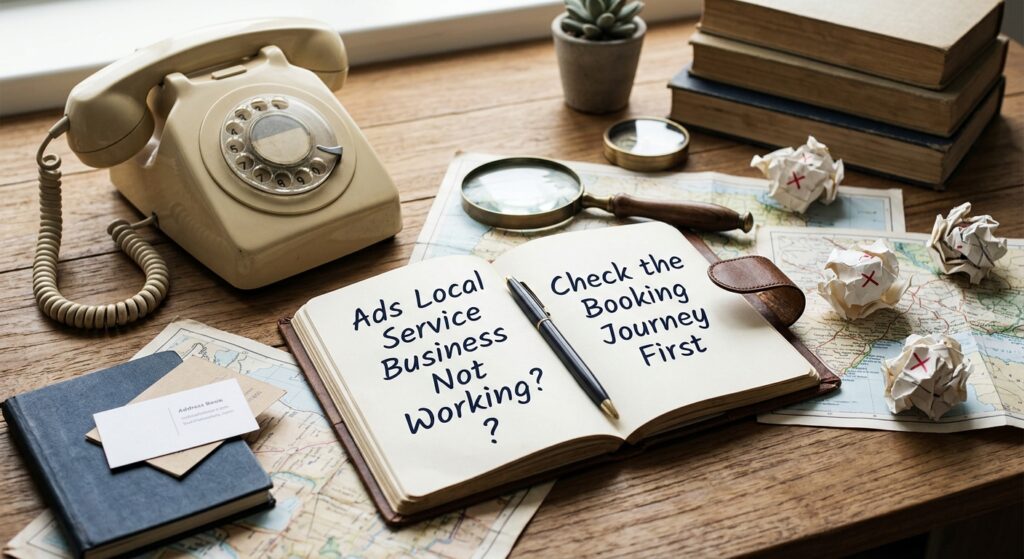
When ads local service business not working is the complaint, it is tempting to blame the audience, creative, budget, or platform.
Sometimes those things really are responsible. However, there is another possibility: the ads are generating interest, but the business is losing people after the click or lead submission. Suppose a contractor spends $500 on Meta ads and receives 25 enquiries. On the surface, that sounds like a reasonable campaign. But if only two people schedule an estimate, the business has a booking problem rather than simply an advertising problem.
This is why you should measure the complete journey instead of focusing only on cost per lead.
A useful customer journey is:
Meta ad → lead form → qualification → booking opportunity → appointment → attended appointment → quote → customer
Each stage tells you something different.
If people do not click the ad, your creative or offer may need work. If they click but do not submit the form, your landing experience may be creating friction. If they submit forms but do not book, your follow-up or scheduling process may be the weak point. If they book but fail to attend, your reminders and qualification process may need attention automated booking system meta ads local service business.
This approach prevents you from automatically increasing your ad budget when the real problem is somewhere else.
Meta Business Suite Appointments Not Working? Review Your Setup
People often search for automated booking system meta ads local service business Suite appointments not working when they cannot find the appointment functionality they expect.
Before assuming there is a technical problem, review how your business is structured. Check that the correct business assets are connected, your Facebook Page is properly configured, your advertising account has the appropriate permissions, and the scheduling provider is correctly connected where the relevant appointment feature is available.
It is also important to understand that Meta Business Suite and Meta Ads Manager serve different purposes. Business Suite is broadly used for managing business activity across Meta’s platforms, while Ads Manager provides the detailed environment for creating and managing advertising campaigns. If your goal is lead generation through Meta advertising, start by making sure the campaign itself is configured around the action you actually want.
For businesses that need appointment scheduling, the key question should be:
“Am I optimizing for leads, or am I building a path toward completed appointments?”
That distinction can change how you structure the entire campaign.
Facebook Appointment Booking Works Better When the Offer Is Clear
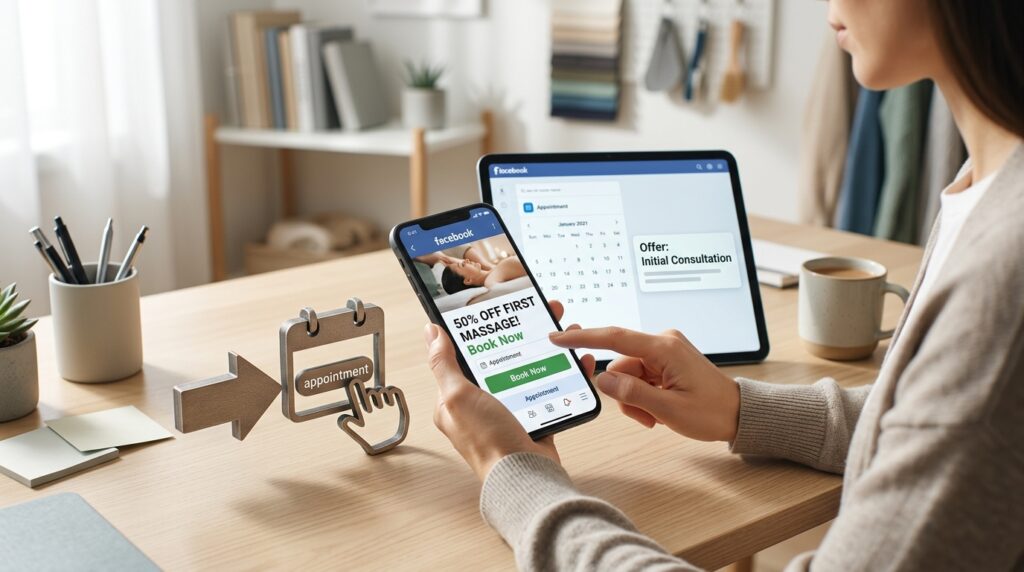
An automated booking system cannot rescue an unclear offer.
If your advertisement says, “We provide quality home improvement services,” the customer has little reason to take action today. Compare that with a more specific offer such as “Book a Free 15-Minute Roof Assessment” or “Schedule Your No-Obligation Plumbing Consultation.”
The second version tells people what they get and what happens next.
For local services, strong offers often reduce the perceived risk of taking the first step. A free consultation, free estimate, inspection, assessment, or introductory appointment can give prospects a simple reason to engage. However, the offer should be genuine and appropriate for the business. The goal is not to attract as many people as possible. It is to attract people who are likely to become customers.
That is one reason an automated booking system can work so well alongside Meta ads. The advertisement creates interest, while the booking process turns that interest into a specific next step.
Meta Appointments Can Reduce Friction at the Most Important Moment
The biggest advantage of automated appointment scheduling is not that it makes advertising “automatic.”
It is that it can remove unnecessary steps.
The appointment-booking material you supplied highlights this exact principle. A traditional journey can require the customer to submit a form, see a thank-you message, open another website, find a calendar, select a time, and confirm the appointment. Every additional step gives the customer another chance to stop.
An integrated experience can shorten that journey. For local service businesses, this matters because customers are often busy. A homeowner may be between meetings. A property manager may be handling several maintenance requests. A business owner may be looking for a contractor after normal working hours.
If the prospect has to wait until tomorrow to speak with someone, they may move on.
If they can select a suitable time immediately, the business has a better opportunity to secure the appointment while interest is high.
How to Create a Lead Ad Using Meta Ads Manager
If you are learning how to create a lead ad using Meta Ads Manager, begin with the business outcome rather than the advertising interface.
Before opening Ads Manager, decide what you actually want the campaign to produce. If you need appointments, define the appointment clearly. Decide who should book, what service they are booking, how long the appointment should take, and which times are available. Then prepare your booking system.
Your scheduling platform should reflect your real availability. There is little value in generating appointments if the calendar shows times when your team is unavailable. Next, create the Meta campaign around lead generation or the appropriate appointment-focused setup available to your account. Your audience should be based on your actual service area. A local contractor who only works within 20 miles of the business should not spend heavily targeting people hundreds of miles away.
After that, create the advertisement.
Use straightforward language. Instead of trying to sound overly clever, explain the service and the next step.
For example:
“Need a Roof Inspection? Book a Free Local Assessment.”
The customer immediately understands the problem, the service, and the action. Then build the lead form with only the information you genuinely need. Finally, connect the booking experience and test the entire journey yourself before spending heavily.
Submit the form as though you were a customer. Check the confirmation. Check the calendar. Select an appointment. Confirm the notification arrives. Then check what happens inside your CRM or booking system. This simple test can reveal problems before real prospects encounter them.
Build an Automated Booking System Meta Ads Local Service Business Workflow
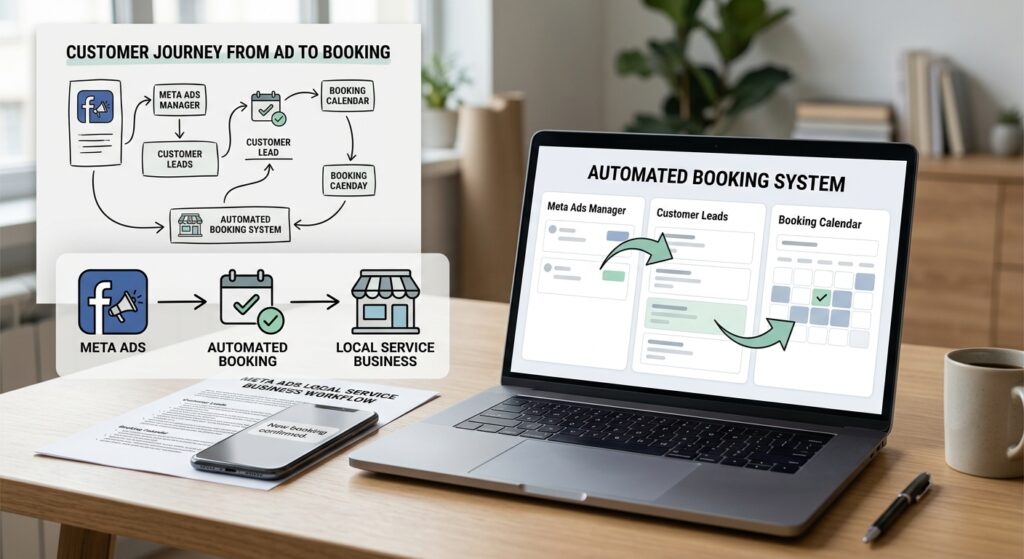
A strong automated booking system meta ads local service business workflow should connect advertising, scheduling, communication, and measurement. The first component is Meta advertising. This is where you attract people who may need your service. The second component is the lead form. It collects the basic information needed to continue the conversation.
The third component is the scheduling system. This gives qualified prospects an opportunity to select an appointment. The fourth component is your CRM or customer-management system. This is where you can organize leads, appointments, follow-ups, and customer status.
The fifth component is tracking.
Tracking matters because a cheap lead is not necessarily a valuable lead. Suppose Campaign A generates leads at $10 each, while Campaign B generates leads at $25 each. At first glance, Campaign A appears better.
Campaign B may actually be far more profitable.
This is why businesses should eventually measure qualified leads, appointments booked, appointments attended, customers won, and revenue, rather than stopping at lead volume. Meta’s Conversions API is designed to help businesses send conversion information to Meta from their servers or other connected systems. It can be useful as part of a broader measurement setup, although implementation should be handled carefully and consistently with applicable privacy requirements.
Connect Your Booking System With First-Party Data
The automated booking system meta ads local service business supplied material about Meta’s appointment update also emphasizes the growing importance of first-party data. This is important because the lead is only the beginning of the customer journey.
- Imagine a contractor receives 100 leads.
- Thirty book appointments.
- Twenty-five attend.
- Ten request quotes.
- Five become paying customers.
If you only track the first 100 leads, you do not know which advertising activity is actually producing business. A more mature system connects those stages. That allows the business to understand not only which advertisement generated a lead, but which advertising activity ultimately contributed to customers.
This is one of the biggest differences between simply “running Facebook ads” and building a proper local service lead-generation system.
Automated Booking System Meta Ads Local Service Business Creative Strategy
Your booking system may be excellent, but people still need a reason to click your advertisement.
For local service businesses, authentic creative can be more useful than overly polished stock imagery.
- A contractor could show a short video of a real project.
- A plumber could demonstrate a common plumbing problem.
- A landscaper could show the transformation of a backyard.
- A cleaning company could show a before-and-after project.
These examples give potential customers something concrete to understand. The advertisement should then connect the visual with a simple offer and a clear action.
For example:
“Planning a Bathroom Renovation? Book a Free 15-Minute Consultation.”
- The creative gets attention.
- The copy explains the value.
- The CTA tells the prospect what to do.
- The booking system handles the next step.
That is a much stronger structure than simply boosting an image and hoping someone calls.
Is an Automated Booking System Worth It for a Local Service Business?

If your automated booking system meta ads local service business campaign is receiving clicks but few bookings, do not immediately increase the budget.
For a business that regularly schedules consultations, estimates, inspections, appointments, or service calls, an automated booking system can be a valuable addition to a Meta advertising strategy. It is especially useful when the business has a predictable service area, clear appointment types, defined availability, and enough demand to justify improving the booking process.
It is less useful when the service requires extensive custom quoting before an appointment can be scheduled or when every enquiry needs a completely different process.
The important point is that automated booking system meta ads local service business should fit the business model.
You do not need automation simply because it is fashionable. You need it when it solves a real problem. If your team is spending hours manually calling leads, chasing people for availability, and trying to coordinate appointments, automation may remove a significant amount of repetitive work.
Final Thoughts on Automated Booking System Meta Ads Local Service Business
An automated booking system meta ads local service business strategy is about more than connecting a Facebook ad to a calendar.
It is about building a smoother customer journey. The advertisement creates awareness. The offer creates interest. The lead form captures information. The booking system turns interest into an appointment. Automated reminders keep the customer informed. Your sales team handles the human conversation. Finally, tracking shows which campaigns are producing real business results.
That approach is much more powerful than measuring success by clicks or lead volume alone.
The biggest opportunity for local service businesses is to stop thinking of Meta ads as a si mple source of enquiries and start treating them as part of an automated booking system meta ads local service business customer acquisition system. When the pieces work together, prospects have fewer steps to complete, businesses spend less time chasing every enquiry, and marketing teams gain a clearer view of what actually drives revenue.
For businesses already investing in Meta advertising, the next logical step is not always spending more. Sometimes the better move is improving what happens after the person responds to the ad. That is where an automated booking workflow can turn advertising activity into a more organized, measurable, and scalable sales process.
FAQ’S…
How much do 1000 clicks cost on Facebook?
The cost of 1,000 Facebook clicks varies by industry, audience, location, and campaign quality. For an automated booking system meta ads local service business campaign, focus on cost per qualified lead and booked appointment rather than clicks alone.
How to automate Meta ads?
You can automate Meta ads using automated rules, campaign-management platforms, CRM integrations, and conversion tracking. For an automated booking system meta ads local service business strategy, connect your ads with lead forms, scheduling, follow-ups, and conversion tracking to reduce manual work.
What is the 3 2 2 method of Facebook ads?
The 3-2-2 method generally refers to testing 3 creatives, 2 audiences, and 2 variations to discover which combinations perform best. For an automated booking system meta ads local service business campaign, structured testing can help identify which ads generate qualified bookings.
Which AI tool is best for Facebook ads?
There is no single best AI tool for every business. Tools such as AdStellar can assist with creative generation and campaign workflows, while Meta’s native tools provide direct campaign management. For an automated booking system meta ads local service business, choose based on your creative, optimization, and automation needs.
What are common FB ads mistakes to avoid?
Common mistakes include targeting the wrong service area, using weak offers, optimizing only for clicks, creating poor-quality forms, ignoring lead quality, and failing to follow up quickly. An automated booking system meta ads local service business approach can help connect advertising, qualification, scheduling, and follow-up.
How much money can I expect to get for 10,000 views on Facebook?
There is no fixed amount you earn from 10,000 Facebook views. Revenue depends on monetization eligibility, content, audience, and other factors. For businesses using an automated booking system meta ads local service business strategy, the more relevant metric is how many qualified leads and customers those views help generate.