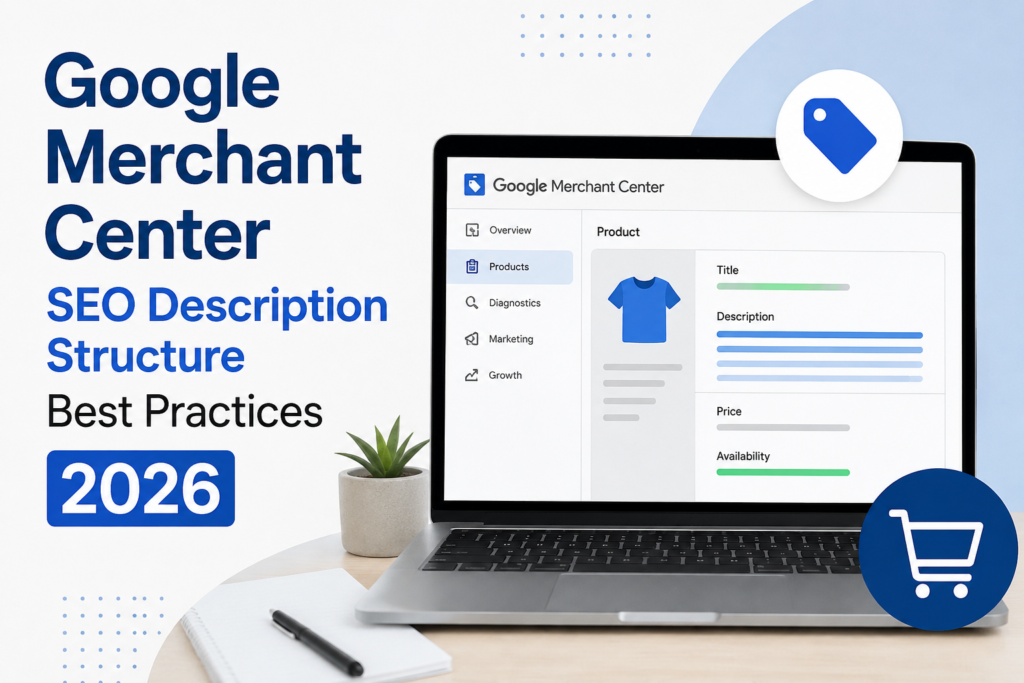
If you’ve ever spent hours optimizing product titles, uploading high-quality images, and configuring your Google Merchant Center SEO Description Best Practices for 2026 feed, only to wonder why your products still struggle to gain visibility, you’re not alone.
Many ecommerce store owners focus heavily on product titles and images while completely overlooking one of the most powerful ranking and conversion assets available to them: product descriptions Google Merchant Center SEO Description Best Practices for 2026.
In 2026, product descriptions are no longer just supporting text sitting beneath your product title. They have become a critical component of Google Shopping optimization, Performance Max campaigns, Merchant Center feeds, and AI-powered shopping experiences.
Think of your product title as the headline of a newspaper article. It grabs attention. However, the product description provides the context Google needs to fully understand your product and determine where it belongs within the shopping ecosystem.
This guide covers the complete Google Merchant Center SEO Description Best Practices 2026, including proven strategies, real-world examples, feed optimization techniques, AI-assisted workflows, and step-by-step implementation methods that can help increase visibility, improve click-through rates, and generate more sales.
Why Product Descriptions Matter More Than Ever in 2026
Many merchants mistakenly assume Google only relies on titles for relevance.
While titles remain extremely important, product descriptions help Google understand:
- Product purpose
- Customer intent
- Product features
- Product benefits
- Technical specifications
- Semantic relationships
- Shopping relevance
Google’s shopping systems have become significantly more sophisticated. Instead of simply matching keywords, Google’s AI systems attempt to understand products the same way a shopper would.
Imagine someone searches:
waterproof hiking boots for snowy mountain trails
A product title may contain:
Waterproof Hiking Boots
However, a detailed description could provide additional context such as:
- Insulated lining
- Snow-resistant materials
- Slip-resistant outsole
- Winter trekking compatibility
- All-weather protection
These extra details help Google determine whether the product truly matches the search intent.
As a result, optimized descriptions often improve visibility across Shopping results, organic search features, merchant listings, and AI-powered shopping experiences.
Understanding What Is SEO and How It Works is essential before optimizing product descriptions.
SEO, or Search Engine Optimization, is the process of helping search engines understand your content so it can appear for relevant searches Google Merchant Center SEO Description Best Practices for 2026.
Traditionally, SEO focused on webpages.
Today, ecommerce SEO extends beyond websites and includes:
- Product feeds
- Product descriptions
- Structured data
- Merchant Center attributes
- Product reviews
- Shopping listings
When Google crawls your ecommerce store, it collects information from multiple sources:
- Product pages
- Product schema
- Merchant Center feeds
- Customer reviews
- Product titles
- Product descriptions
Google then combines these signals to determine:
- Relevance
- Product category
- Search intent alignment
- Shopping eligibility
Therefore, optimizing product descriptions improves Google’s understanding of your products while helping potential customers discover them more easily.
SEO Meaning in Business: Why Product Descriptions Impact Revenue

The SEO Meaning in Business goes far beyond rankings Google Merchant Center SEO Description Best Practices for 2026.
For ecommerce brands, SEO directly impacts:
- Revenue growth
- Customer acquisition
- Advertising efficiency
- Brand visibility
- Conversion rates
Consider two stores selling identical products.
Store A uses generic manufacturer descriptions copied directly from suppliers.
Store B creates unique, optimized descriptions containing:
- Search-focused keywords
- Customer benefits
- Technical specifications
- Product use cases
Over time, Store B typically generates more visibility because Google receives stronger relevance signals.
More visibility often leads to:
- More impressions
- More clicks
- More traffic
- More sales
This is why product descriptions should be viewed as revenue-generating assets rather than basic product information.
Understanding Google’s Product Description Algorithm
Google has never publicly disclosed exactly how much weight descriptions carry Google Merchant Center SEO Description Best Practices for 2026.
However, Google consistently emphasizes:
- Helpful content
- Product accuracy
- User-focused information
- Semantic relevance
Descriptions help fill the information gap that titles cannot cover.
For example, a title may only contain:
Men’s Waterproof Running Shoes
Meanwhile, the description can explain:
- Breathable mesh construction
- Shock-absorbing midsole
- Long-distance comfort
- Rain-resistant materials
- Trail compatibility
Together, these elements create a richer understanding of the product.
Google Merchant Center SEO Description Best Practices for 2026

One of the biggest mistakes merchants make is treating product descriptions like a wall of text.
Instead, descriptions should follow a structured framework.
Section 1: Primary Keywords Within the First 150 Characters
This is arguably the most important section.
The beginning of your description provides immediate relevance signals.
Example:
Waterproof hiking boots for men featuring insulated lining, superior traction, and all-weather protection for outdoor adventures.
Notice how the description immediately includes:
- Product type
- Primary keyword
- Key benefit
- Core feature
Google can instantly understand the product.
Section 2: Product Overview
Next, explain the product’s purpose.
Example:
Designed for outdoor enthusiasts, these hiking boots provide dependable comfort, stability, and weather protection during long treks and challenging terrain.
This establishes context.
Section 3: Features and Specifications
Include factual information such as:
Materials
- Leather
- Cotton
- Aluminum
- Stainless steel
Measurements
- Weight
- Height
- Width
- Capacity
Technical Specifications
- Battery life
- Performance metrics
- Compatibility
Specific details improve product understanding.
Section 4: Benefits
Customers buy outcomes, not features.
Feature:
Memory foam insole
Benefit:
Reduces foot fatigue during extended outdoor activities.
Feature:
Waterproof membrane
Benefit:
Keeps feet dry during rain, snow, and muddy conditions.
Benefits increase conversion potential.
Section 5: Use Cases
Explain who the product serves.
Examples:
- Travelers
- Athletes
- Professionals
- Students
- Outdoor enthusiasts
This creates additional relevance signals.
Section 6: Review-Based Insights
Customer reviews provide some of the most valuable optimization opportunities available.
A real-world example demonstrates this perfectly.
An automotive retailer selling performance air intake systems discovered customers repeatedly wrote:
The turbo sounds incredible.
The retailer incorporated that phrase naturally into product descriptions.
As a result, engagement improved because the description reflected authentic customer language.
Google Merchant Center SEO Description Best Practices for 2026 increasingly values real-world experiences and customer sentiment Google Merchant Center SEO Description Best Practices 2026.
The 180-Character Rule Every Merchant Should Follow:
Although Merchant Center allows lengthy descriptions, the first portion carries disproportionate importance.
The most critical information should appear within the first 145–180 characters.
Include:
- Product name
- Primary keyword
- Brand
- Key feature
- Primary benefit
Example:
Women’s waterproof trail running shoes featuring breathable mesh construction, lightweight cushioning, and superior grip technology for all-weather performance.
This immediately communicates relevance to Google and shoppers Google Merchant Center SEO Description Best Practices for 2026.
SEO Position Meaning: How Product Descriptions Influence Rankings
The SEO Position Meaning refers to where your products appear within search results Google Merchant Center SEO Description Best Practices for 2026.
Higher positions generally receive:
- More visibility
- Higher click-through rates
- Better conversion opportunities
Product descriptions influence rankings by helping Google understand:
- Product relevance
- Search intent
- Semantic relationships
- Product categories
For example, a generic description may simply say:
Wireless Bluetooth headphones.
An optimized version could include:
Noise-canceling Bluetooth headphones with long battery life, premium audio quality, and travel-friendly comfort.
The second description provides significantly more contextual information.
Semantic SEO Keywords That Strengthen Product Relevance
To support Google Merchant Center SEO Description Best Practices 2026, naturally incorporate related keywords such as:
- Ecommerce SEO
- Product Feed Optimization
- Google Shopping Optimization
- Merchant Center Feed
- Shopping Ads
- Performance Max Campaigns
- Product Structured Data
- Product Schema
- Search Intent
- Product Feed Management
- Conversion Optimization
- Merchant Listings
- Product Attributes
- Product Reviews
- Shopping Feed SEO
Avoid keyword stuffing.
Instead, integrate these phrases naturally throughout your descriptions.
SEO Marketing: How Product Feed Optimization Supports Ecommerce Growth
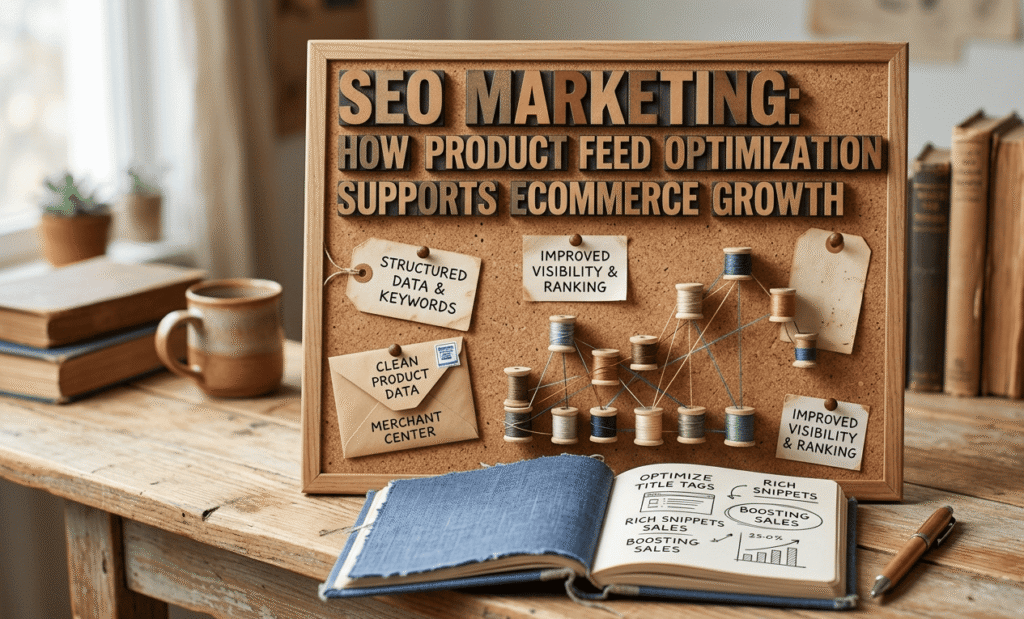
Modern SEO Marketing extends beyond website content.
Today’s ecommerce SEO includes:
- Product feeds
- Structured data
- Merchant Center optimization
- Product descriptions
- Product imagery
- Customer reviews
A well-optimized product description supports multiple marketing Google Merchant Center SEO Description Best Practices for 2026 objectives simultaneously.
It improves:
- Organic visibility
- Shopping visibility
- Conversion rates
- AI search readiness
- Product discoverability
Consequently, merchants should view description optimization as an ongoing marketing investment rather than a one-time task.
Conclusion
As ecommerce competition continues to increase, simply uploading products to Google Merchant Center SEO Description Best Practices for 2026 requires a strategic approach to product feed optimization, and product descriptions play a much larger role than many merchants realize.
By following these Google Merchant Center SEO Description Best Practices for 2026, you can help Google better understand your products, improve Shopping visibility, strengthen relevance signals, and increase your chances of appearing in front of high-intent buyers. While product titles may attract initial attention, descriptions provide the detailed context that powers Google’s understanding of product purpose, features, benefits, and customer intent.
FAQ’S..
How to improve SEO for Google ranking in 2026?
The Google Merchant Center SEO Description Best Practices for 2026 first content, optimizing technical SEO, improving Core Web Vitals, implementing structured data, and strengthening E-E-A-T signals. For ecommerce websites, optimize product feeds, category pages, and product descriptions to improve visibility across Google Search, Shopping, and AI-powered search experiences.
What are the 4 types of SEO?
The four main types of SEO are On-Page SEO, Off-Page SEO, Technical SEO, and Local SEO. Together, these strategies help improve website visibility, search rankings, user experience, and organic traffic from search engines like Google.
How to rank high on Google SEO?
To rank higher on Google, create high-quality content that matches search intent, optimize titles and meta descriptions, improve page speed, build authoritative backlinks, use relevant keywords naturally, and ensure your website is technically sound and mobile-friendly.
What is the most searched thing in Google?
The most searched topics on Google constantly change based on trends, news, entertainment, sports, and technology. However, searches related to weather, social media platforms, online shopping, current events, and popular celebrities consistently rank among the most searched topics worldwide.
Is SEO dead or evolving in 2026?
SEO is not dead; it is evolving rapidly. In 2026, SEO includes traditional search optimization, AI search visibility, structured data, user experience, brand authority, and ecommerce optimization. Businesses that adapt to these changes continue to gain traffic, visibility, and long-term growth.