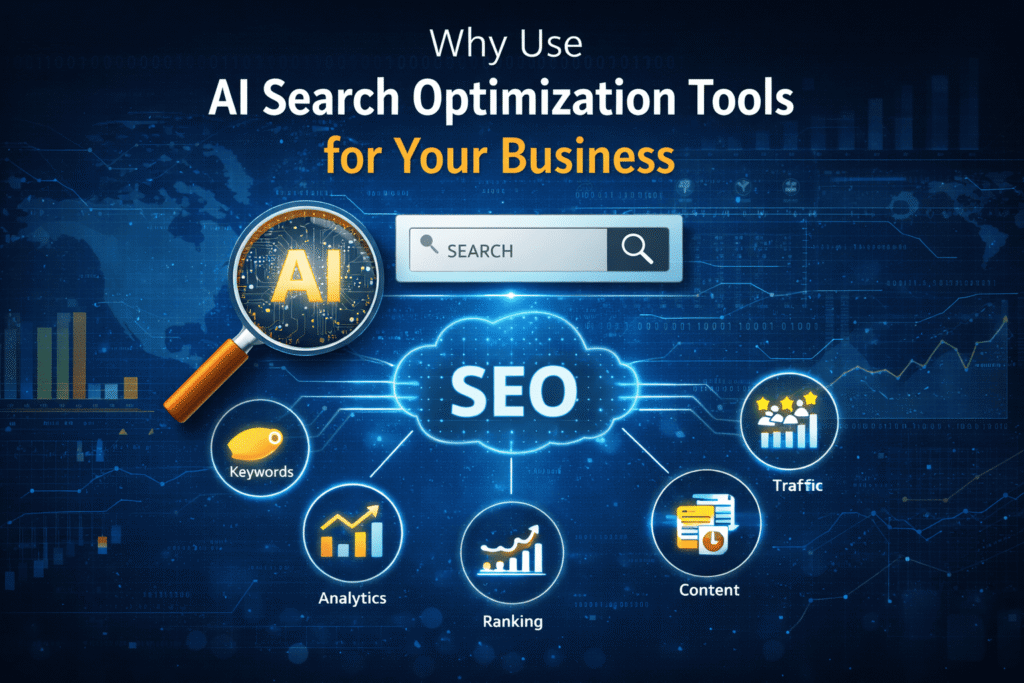
In today’s highly competitive digital landscape, businesses can no longer rely solely on traditional search strategies. With the rapid rise of AI-powered platforms, understanding why use AI search optimization tools for your business is crucial for capturing visibility, leads, and authority. These tools ensure your content is structured, citation-worthy, and discoverable by AI systems like ChatGPT, Perplexity AI, and Google AI Overview.
Imagine this scenario: your competitor appears at the top of AI-generated results while your business remains invisible. Every day, potential customers are asking AI platforms for guidance, recommendations, and solutions. If your brand isn’t appearing, you’re missing opportunities. This is where AI search optimization tools become your secret weapon for growth and visibility.
SEO vs AI Optimization: Understanding the New Search Landscape
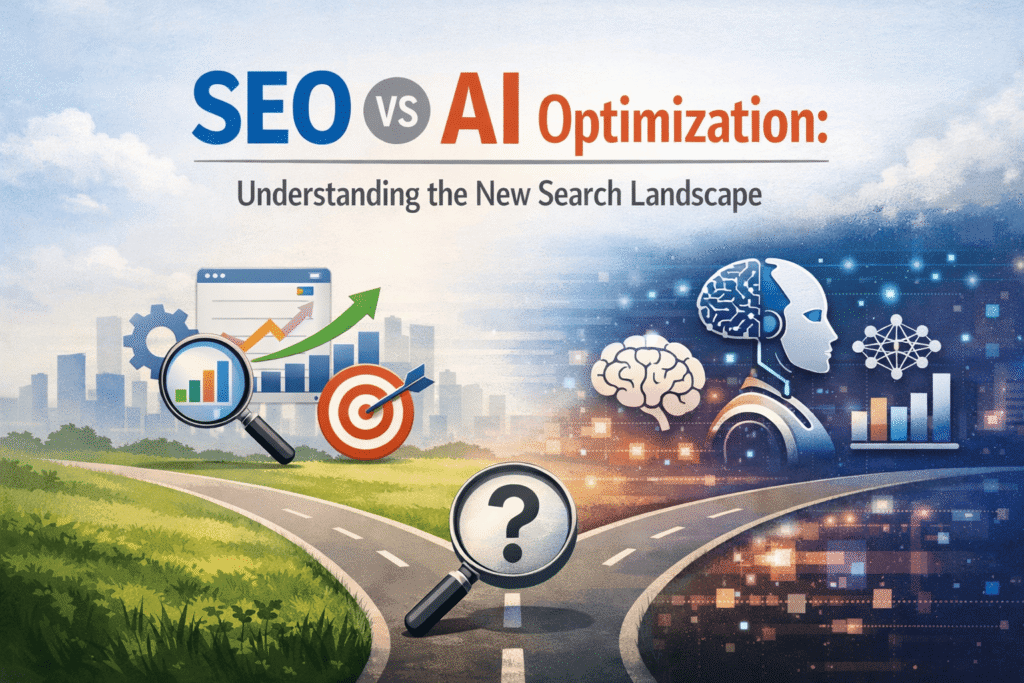
While SEO has been the backbone of digital marketing for decades, the rise of AI search is creating a new layer of complexity. . In contrast, AI optimization ensures your content is recognized as an authoritative answer by AI platforms.
For example, imagine a customer asking ChatGPT, “Which marketing automation tool is best for a 50-person company?” Even if your website ranks #1 on Google, it may not appear in AI-generated responses. That’s the visibility gap AI search optimization tools fill—positioning your business as the trusted authority before traditional search traffic even begins why use ai search optimization tools for your business.
Key differences between SEO and AI optimization include:
- SEO: Measures rankings on search engines and focuses on user clicks.
- AI optimization: Measures citation-worthiness in AI-generated answers and satisfies user intent early.
- SEO vs AI optimization: Traditional metrics may still matter, but AI platforms prioritize structured, authoritative, and well-cited content.
SEO for AI Search: How to Make Your Content AI-Ready
SEO for AI search is the process of preparing your content so AI systems can understand, trust, and cite it. This involves more than just writing blog posts—it’s about structured data, authoritative sources, and clear answers to common industry questions.
Steps to Optimize for AI Search
- Audit Your Current AI Visibility
Search your brand or products on ChatGPT, Perplexity, and Google AI Overview. Track whether your business appears and who gets cited instead. - Identify Content Gaps
Analyze AI-cited competitors’ content. What questions do they answer? Which solutions do they provide? - Structure Your Content for AI Comprehension
Use headings, bullet points, tables, and concise answers. AI models prefer well-organized information that is easily parsed. - Incorporate Authoritative Citations
References from reputable sites, PR mentions, and industry directories increase the likelihood of AI recognition. - Monitor and Update Regularly
AI algorithms evolve rapidly. Track your AI visibility metrics and continuously optimize your content.
What Is SEO for AI Called and Why It Matters
Many businesses ask, “what is SEO for AI called?” The answer is Generative Engine Optimization (GEO). GEO focuses on ensuring your content is structured, credible, and AI citation-ready, allowing your business to appear in AI-generated answers for high-intent queries.
GEO isn’t just “SEO 2.0”—it’s a fundamental shift in how search engines evaluate content. Large language models assess:
- Content authority
- Citation frequency from trusted sources
- Structured and semantic clarity
By understanding what is SEO for AI called, businesses can implement strategies that work across both AI-driven and traditional search platforms.
How to Use AI for SEO: Step-by-Step Guide
How to use AI for SEO effectively is one of the most common questions among marketers today. Here’s a practical framework:
Step 1: Perform an AI Search Audit
Check how AI platforms like ChatGPT, Perplexity, and Google AI Overview reference your content. Document gaps and opportunities.
Step 2: Optimize High-Impact Pages
Focus on pages with high traffic potential or existing keyword authority. Structure answers for AI comprehension.
Step 3: Implement Structured Data
Use schema markup for products, reviews, FAQs, and guides. AI models parse structured data more efficiently.
Step 4: Build Authority Signals
Get citations on authoritative sites, press mentions, and social media. AI systems prioritize sources referenced externally.
Step 5: Monitor AI Visibility
Track AI mentions, recommendation contexts, and lead generation. Adjust your content based on analytics why use ai search optimization tools for your business.
Best AI SEO Tools for Businesses
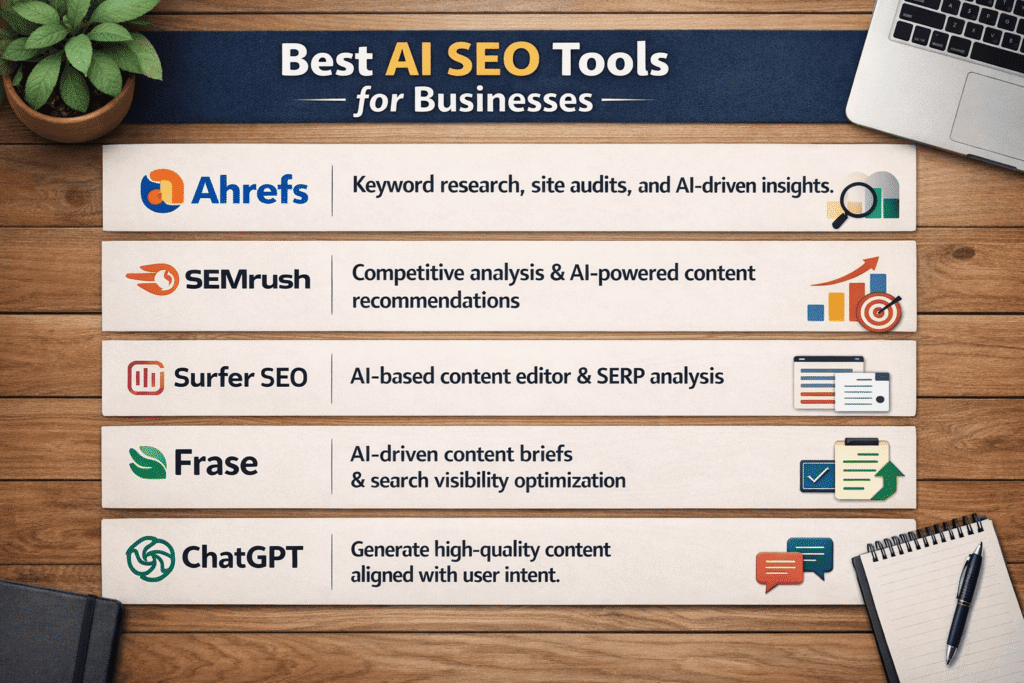
Choosing the best AI SEO tools can be daunting, but the right tools make implementation seamless. Popular options include:
- Ahrefs – Keyword research, site audits, and AI-driven insights.
- SEMrush – Competitive analysis and AI-powered content recommendations.
- Surfer SEO – AI-based content editor and SERP analysis.
- Frase – AI-driven content briefs and optimization for search visibility.
- ChatGPT – Generate high-quality content aligned with user intent.
These tools improve both traditional SEO and AI visibility, ensuring your content is cited in AI-powered search results.
AI Search Optimization Course: Learning the Fundamentals
If your team is new to AI search optimization, investing in an AI search optimization course can accelerate results. Courses cover:
- GEO strategy fundamentals
- Content structuring for AI comprehension
- Citation-building techniques
- Analytics tracking and measurement
Training ensures your team can confidently implement AI optimization while maintaining traditional SEO efforts.
Future of SEO with AI: Trends and Predictions
The future of SEO with AI is intertwined with generative search technology. Here’s what to expect:
- AI will handle an increasing portion of search queries, reducing traditional click-throughs.
- Businesses that fail to adopt AI optimization risk losing visibility to competitors.
- SEO strategies will evolve to combine traditional ranking tactics with AI citation strategies.
The bottom line: businesses that embrace SEO in AI age will capture early visibility, high-quality leads, and a strong share of voice across platforms.
SEO in AI Age: Maximizing ROI and Competitive Advantage
By integrating SEO in AI age strategies, your business can:
- Capture intent before competitors do
- Build authority that AI systems trust
- Future-proof digital presence for emerging AI platforms
- Maximize ROI across multiple search channels
- Generate pre-qualified leads ready to convert
Early adopters gain a first-mover advantage, establishing credibility before competitors even start optimizing.
Real-World Examples and Anecdotes

Sarah, a small e-commerce business owner, was struggling to attract new leads despite ranking high on Google. After implementing AI search optimization tools and structuring content for GEO, her brand appeared in ChatGPT recommendations for product queries. Within three months, she saw a 25% increase in pre-qualified leads, illustrating how AI search captures prospects before they visit your site.
Similarly, a B2B SaaS company optimized feature comparison content for AI. Their ChatGPT citations helped them dominate industry recommendations, resulting in a 35% lift in qualified leads within 90 days. These stories prove the power of why use ai search optimization tools for your business for tangible business results.
Common Misconceptions About AI Optimization
- “AI optimization replaces SEO” – False. Both strategies work together.
- “Results are instant” – False. AI systems may take 60–90 days to cite content.
- “Any tool will work” – False. Only tools with AI citation tracking can measure impact.
- “Once optimized, you’re done” – False. Continuous updates are required as AI evolves.
Measuring ROI for AI Search Optimization Tools
Unlike traditional SEO, GEO success is measured by:
- Frequency of AI mentions
- Context in which your business is recommended
- Citation quality across authoritative sources
- Lead generation from AI referrals
Most businesses see positive ROI within 90 days, especially why use ai search optimization tools for your business with traditional SEO.
Conclusion
Understanding why use AI search optimization tools for your business is no longer optional. AI search platforms are capturing market share, changing buyer behavior, and redefining visibility. Investing in AI search optimization tools, adopting GEO strategies, and training your team with an AI search optimization course ensures your business remains visible, trusted, and competitive.
Start today and position your brand as the authoritative choice in the AI-powered search landscape.
Primary Keyword: why use AI search optimization tools for your business
Secondary Keywords: SEO vs AI optimization, SEO for AI search, What is SEO for AI called, How to use AI for SEO, Best AI SEO tools, AI search optimization course, Future of SEO with AI, SEO in AI age
Hyperlinks Added: ChatGPT, Perplexity AI, Google AI Overview, Ahrefs, SEMrush, Surfer SEO, Frase, GEO-Lens, Schema.org, AI SEO courses
FAQ’S..
What are the advantages of using AI tools in business?
AI tools help businesses save time, reduce manual work, improve accuracy, and make faster decisions. They support customer service, content creation, data analysis, and workflow automation. This leads to better productivity, lower costs, and improved customer experience.
What are the 4 pillars of SEO
The four main pillars of SEO are technical SEO, on page SEO, content, and off page SEO. Together, they help search engines crawl your website, understand your pages, trust your authority, and rank your content higher in search results.
What are the benefits of AI SEO tools?
AI SEO tools speed up keyword research, content planning, competitor analysis, site audits, and optimization. They help find ranking opportunities, improve content relevance, and save time on repetitive SEO tasks. This makes SEO work more efficient and data driven.
What are the benefits of AI optimization?
AI optimization improves performance by analyzing data quickly and making smarter recommendations. It can enhance content quality, automate tasks, improve targeting, and increase efficiency. Businesses use it to boost accuracy, save resources, and achieve better results faster.
Why is SEO important for small businesses?
SEO helps small businesses appear in search results when potential customers are looking for their services. It increases visibility, drives organic traffic, builds trust, and generates leads without relying only on paid ads. This makes it a cost effective long term marketing strategy.
Which business needs SEO?
Any business that wants online visibility can benefit from SEO. This includes local shops, service providers, ecommerce stores, startups, agencies, healthcare clinics, and large companies. If customers search for your products or services online, your business needs SEO.
What are the three pillars of local SEO?
The three pillars of local SEO are relevance, distance, and prominence. Relevance means how well your business matches a search, distance refers to how close you are to the searcher, and prominence shows how trusted and well known your business is online.