
If you have ever opened your Google Analytics dashboard and felt frustrated seeing “(not provided)”, you are not alone. This guide will help you clearly understand what does not provided mean in Google Analytics keywords, why it happens, and how you can still win at SEO using smart strategies.
In simple words, not provided meaning refers to hidden search query data that Google does not show to protect user privacy. This change has forced marketers to adopt smarter, data-driven SEO strategies.
In this powerful guide, we will explore:
- What not provided Google Analytics means
- Why keyword data is hidden
- Proven SEO recovery strategies
- Future SEO trends using AI and intent optimization
Let’s begin.
What Does Not Provided Mean in Google Analytics Keywords?
The phrase what does not provided mean in Google Analytics keywords refers to search traffic data that Google intentionally hides from reporting dashboards.
This change began when Google introduced encrypted search protocols around 2011 to improve user privacy protection.
Learn more about search privacy here.
Today, when users search while logged into Google accounts or use secure browsing, their exact search terms are replaced with (not provided).
Instead of seeing:
- “Best SEO services”
You may only see:
- (not provided) traffic entries.
Why Google Introduced Not Provided Google Analytics Protection
Google implemented this security update to protect user data and search behavior privacy.
Modern internet users expect strong privacy protection across search platforms.
Read how search privacy works here:
However, this created challenges for SEO professionals who previously relied heavily on keyword-level reporting.
Negative Impact of Not Provided Meaning on SEO Reporting
The rise of not provided Google Analytics reporting caused several challenges:
Reduced Keyword Tracking Accuracy
Marketers cannot easily track:
- Exact search queries
- Customer purchase keywords
- Long-tail traffic performance
Difficult SEO ROI Measurement
Campaign success now depends on:
- Engagement metrics
- Traffic quality
- Conversion performance
Content Planning Challenges
SEO teams must rely more on:
- Audience research
- Competitor analysis
- Topic modeling
Despite limitations, SEO performance can still be measured using alternative tools in what does not provided mean in Google Analytics keywords.
Smart SEO Thinking in the Era of Not Provided Keywords
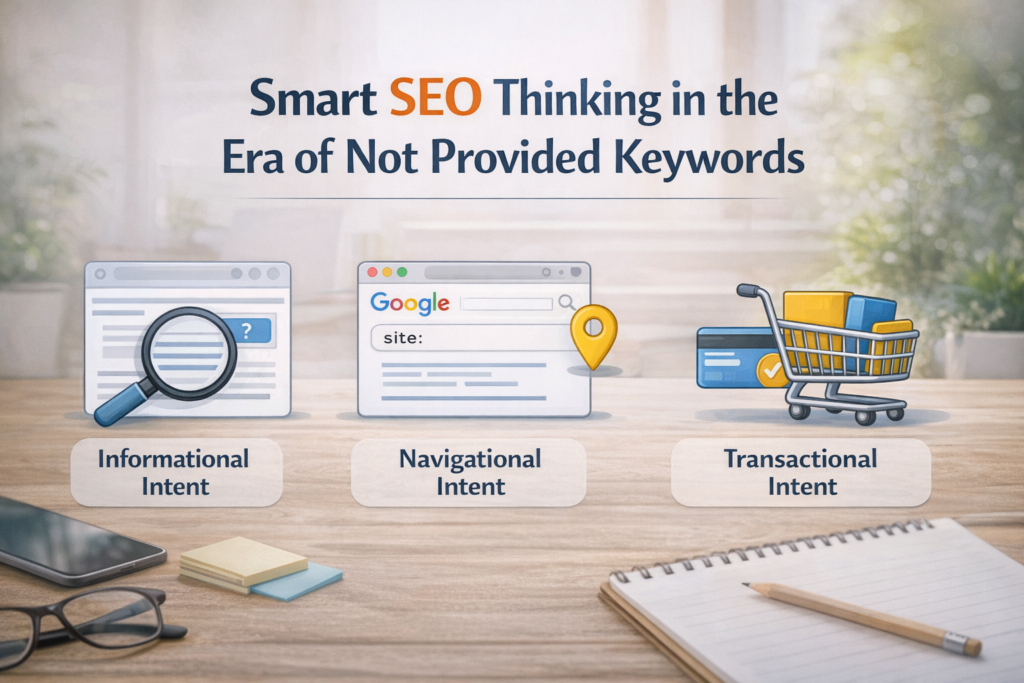
Modern SEO is shifting from keyword obsession to search intent optimization.
Search intent categories include:
Informational Intent
Users search for knowledge.
Examples:
- How does SEO work?
- What is digital marketing?
Navigational Intent
Users search for specific websites or brands.
Brand authority is extremely important for this type of search behavior.
Transactional Intent
Users want to buy products or services.
Example:
- Best SEO tools pricing
- Buy marketing software online
Conversion-focused SEO is critical here.
Powerful Step-by-Step Guide to Beat Not Provided Google Analytics Data
Even though Google hides keywords, you can still win at SEO analytics.
Step 1: Use Google Search Console (Best Free Solution ):
Then:
- Verify website ownership
- Open Performance Report
- Analyze:
- Clicks
- CTR
- Impressions
- Ranking position
This is the strongest free replacement for missing keyword data.
Step 2: Analyze High-Performing Landing Pages
Inside Google Analytics:
- Open Engagement Reports
- Click Landing Pages
- Filter organic traffic
Then ask:
- What problem does this page solve?
- What search intent does it match?
Landing page behavior reveals hidden keyword clues.
Step 3: Use Premium SEO Intelligence Tools
Professional marketers use advanced SEO platforms:
These tools provide:
- Competitor keyword research
- Ranking tracking
- Traffic estimates
Step 4: Track Internal Website Search Behavior
If your website has a search bar, monitor internal queries.
This helps discover:
- Customer needs
- Product interests
- Content demand patterns
Analytics tracking guide:
Step 5: Run High-Conversion PPC Campaigns
Paid advertising provides real search query data.
Use Google Ads:
You can discover:
- High-converting search phrases
- Buyer behavior signals
Advanced SEO Growth Strategies for Modern Marketing Success

Topic Authority Content Strategy
Build content clusters around main themes.
Example:
Main Topic → SEO Marketing
Subtopics →
- Link building
- Content marketing
- Technical SEO
Improve Website User Experience (UX)
Search engines reward user-friendly websites.
Focus on:
- Fast loading speed
- Mobile optimization
- Clear navigation
Performance optimization guide:
Create Helpful, High-Quality Content
Avoid outdated SEO tricks like keyword stuffing.
Instead:
- Write naturally
- Answer user questions directly
- Provide real value solutions
Content quality guidelines:
Why Businesses Must Invest in Professional SEO Services
Professional SEO delivers long-term business benefits:
Strong organic visibility
Brand authority growth
Higher conversion rates
Sustainable traffic growth
Think of SEO as building long-term digital business assets.
Future of SEO Beyond Not Provided Keywords
The future of SEO is powered by AI and smart search technologies:
- AI search assistants
- Voice search optimization
- Semantic SEO ranking
- Behavioral search signals
Learn semantic search:
Real Success Story Insight
Businesses that stopped chasing exact keywords and started focusing on:
- Customer experience
- Content quality
- Authority building
Achieved stronger search rankings and sustainable growth.
SEO is about solving problems, not just targeting keywords.
Conclusion
Understanding what does not provided mean in Google Analytics keywords is essential for modern SEO success.
Instead of worrying about missing data, focus on:
- User intent
- Content quality
- Multi-tool analytics
- Customer behavior insights
The future belongs to businesses that adapt to AI-driven search and privacy-focused analytics.
Take Action Now for SEO Growth
Invest in smart SEO strategies and professional optimization services to stay ahead of competitors and improve search visibility what does not provided mean in Google Analytics keywords.
FAQ’S..
What are the 4 types of keywords?
The four main types are informational, navigational, transactional, and commercial investigation keywords. They reflect user intent—whether someone wants to learn, find a specific site, make a purchase, or compare options before buying.
Why are my keywords not ranking?
Your keywords may not rank due to low content quality, poor search intent match, weak backlinks, technical SEO issues, slow page speed, or strong competition. Conduct keyword research and improve on-page optimization and authority signals.
What are things that Google Analytics cannot tell you?
Google Analytics cannot show exact keyword data for many searches (“not provided”), competitor strategies, direct ranking positions, or full user intent. It also cannot measure offline conversions unless properly integrated.
What is Google’s 20% rule?
Google’s “20% rule” refers to the idea that employees could spend about 20% of their time working on innovative side projects. It encouraged creativity and led to products like Gmail and Google News.
How to get 100% SEO?
You cannot achieve 100% SEO perfection because algorithms constantly change. However, you can optimize technical SEO, create high-quality content, build backlinks, improve user experience, and match search intent to maximize performance.
Why are people moving away from Google Analytics?
Some users are shifting due to privacy concerns, data complexity, the transition to GA4, and preference for simpler or privacy-focused analytics tools. Businesses often seek platforms that offer clearer insights or easier compliance.